When I look back on this time I will hope to reflect that one of the good things to come out of the Covid-19 lockdown will be 'The Phil More's Corner Podcast'.
The Podcast has its origins in a small Whatsapp group comprising of yours truly and three more of my old fellow Cork birders Brian Lynch, Sean Ronayne and Harry Hussey. I enjoyed our ramblings on our Whatsapp group and suggested one day we turn that into a Podcast. I know nothing about Podcasting and that's probably evident in the quality of the first episode. But hopefully in time it will evolve and improve.
Episode 1 is now up on iTunes.
https://podcasts.apple.com/ie/podcast/the-phil-mores-corner-podcast/id1515168200
Feel free to take a listen, apologies for the ropey sound quality at times. Topics, questions and suggestionsfor future episodes are most welcome.
Wednesday, 27 May 2020

Monday, 25 May 2020
Slowing unlocking
Where to begin! Well, let's start where I left off. I'd reached #85 on my '5kmsfromhome' list but I knew that adding more was going to take effort and luck. I took Monday 11th May off and cycled to the very edge of my 5 kilometer circle. This took me out into open countryside where I added Yellowhammer, Red Kite and Sand Martin thereby bringing me to #88.
For most of the rest of week, the wind was a cold north-easterly, which didn't help matters. A lifting of restrictions from Wednesday 13th May meant no limit on the amount of daily exercise and allowed people to drive to exercise. But, in reality it didn't change that much and much all as I would have liked to bird the coast that weekend we decided that small coastal locations like Happisburgh and Walcott might not be ready to receive visitors that soon.
On Friday evening I drove up to Buxton Heath. I had one churring Nightjar at dusk but it shut-up quite quickly as the wind picked up and the temperature dropped. On Sunday I cycled to Buxton Heath with Nick via Marriott's Way. Nick was using phermone lures to attract Large Red-belted Clearwing (at which he was successful). I wandered around the paths hoping in vain to stumble upon a roosting Nightjar, the very definition of 'a needle in the haystack'. I did enjoy the site of two Cuckoos squabbling over the best singing branch though.
That night local birder Will Soar was awoken in the early hours by a singing Quail at Bowthorpe Marsh. I walked down there on Monday evening around 9pm in hope rather than expectation and was delighted when the bird starting singing at 9.30pm. Will's excellent find brought my total to #89!
It got even better the following evening when Stuart White posted on the Whatsapp group that he thought he had a Corncrake at Thorpe Marshes. Stuart is a very competent birder so I headed over to Thorpe Marshes more or less straight away and only needed to wait 10 minutes before the bird craked loudly from a rather perfect looking nettle bed. Thorpe Marshes is approximately 7 kilometers from home as the Corncrake flies so I couldn't add this to my list but so what, a great bird to see or hear anywhere.
The rest of the week was quiet. I stopped off at East Wretham Heath on the way home from work on Friday to see if any Redstarts had managed to find their way there this year but strong winds put paid to that. In fact Saturday and Sunday were very blustery and it was only today Monday where I felt it was worth going out.
I returned to East Wretham Heath and decided to walk part of Peddar's Way towards the A11. All I could see / hear were Blackcaps so I turned back towards the heath where upon I met several birders following up on a report of a singing Golden Oriole. Whilst I didn't see or hear anything like that myself, I did have three singing male Redstarts - much to my delight. Photos are a bit ropey but at least its proof that there are at least three birds on the reserve in song (I heard there are in fact four - which is great news).


I also had several singing Woodlarks and total of four Cuckoos during the morning (two at East Wretham and two more near Santon Downham).
 |
| Red Kite, Colney, Norwich - 11 May 2020 |
On Friday evening I drove up to Buxton Heath. I had one churring Nightjar at dusk but it shut-up quite quickly as the wind picked up and the temperature dropped. On Sunday I cycled to Buxton Heath with Nick via Marriott's Way. Nick was using phermone lures to attract Large Red-belted Clearwing (at which he was successful). I wandered around the paths hoping in vain to stumble upon a roosting Nightjar, the very definition of 'a needle in the haystack'. I did enjoy the site of two Cuckoos squabbling over the best singing branch though.
That night local birder Will Soar was awoken in the early hours by a singing Quail at Bowthorpe Marsh. I walked down there on Monday evening around 9pm in hope rather than expectation and was delighted when the bird starting singing at 9.30pm. Will's excellent find brought my total to #89!
It got even better the following evening when Stuart White posted on the Whatsapp group that he thought he had a Corncrake at Thorpe Marshes. Stuart is a very competent birder so I headed over to Thorpe Marshes more or less straight away and only needed to wait 10 minutes before the bird craked loudly from a rather perfect looking nettle bed. Thorpe Marshes is approximately 7 kilometers from home as the Corncrake flies so I couldn't add this to my list but so what, a great bird to see or hear anywhere.
The rest of the week was quiet. I stopped off at East Wretham Heath on the way home from work on Friday to see if any Redstarts had managed to find their way there this year but strong winds put paid to that. In fact Saturday and Sunday were very blustery and it was only today Monday where I felt it was worth going out.
I returned to East Wretham Heath and decided to walk part of Peddar's Way towards the A11. All I could see / hear were Blackcaps so I turned back towards the heath where upon I met several birders following up on a report of a singing Golden Oriole. Whilst I didn't see or hear anything like that myself, I did have three singing male Redstarts - much to my delight. Photos are a bit ropey but at least its proof that there are at least three birds on the reserve in song (I heard there are in fact four - which is great news).


 |
| Three different singing Common Redstarts - East Wretham Heath - 25 May 2020 |
Sunday, 10 May 2020
Totally Locked!
I'm actually starting to quite enjoy this whole lockdown thingie! Well, kind of. But it has its advantages. The '2kmfromhome' competition has given me an enthusiasm that I haven't felt about birding for many years. Furthermore, its now the '5kmfromhome' competition so that has offered some further opportunities to me.
On my last post a week ago I was at 76. That's increased in the last week to 85 and although I'm unlikely to increase much beyond this, the last week has included some quality birds.
It started with a fruitless search around Queen's Hill Estate in Costessey looking for a pair Firecrests found by James Lowen. Firecrests are popping up all over the place so hopefully I will add that to the list soon. I was back home and just about to sit down to dinner when Nick called to say there was a Little Ringed Plover on the deck down at Bowthorpe Marsh. Cue a quick dash out of the front door and down the hill to see that. Then, at about 9pm that evening, I saw a Whatsapp message to say that a Cuckoo had been calling from the edge of Colney Gravel Pits at 8.30pm. This was the same Cuckoo that had eluded me twice already. It's literally a 2 minute walk so I popped out but no luck. He continued to elude me the next morning and again on Monday night. Although I did add Grey Wagtail to my list in the meantime. His elusiveness continued again on Tuesday evening too.
On Wednesday my new bike arrived so I was now going to be able to cover more ground within my 5km circle. I cycled down to UEA to check the stretch of river bank behind the Sainsbury's Centre where a Cuckoo had been reported a day previously. Of course, no luck with this one either. I checked along the boardwalk below the UEA broad where Cuckoos are often seen and again no joy. But there were plenty of Sedge Warblers and at least one Garden Warbler too. I cycled back as dusk settled and decided for one quick check of the elusive Colney Cuckoo and guess what!
I rose early on Friday morning and pedalled into Norwich City Centre to search for singing Black Redstart. I was just thinking this would be a tricky bird as I reached the junction of Westlegate and All Saints Green. I sat down on a bench facing John Lewis and played Black Redstart song on my iphone to familarise myself with it (very long time since I heard one sing), when a male bird popped up on the edge of the building to my right and sang for at least the next 15 minutes. Result!
No sooner had I finished there when news came through of a male Wheatear amongst the log pile just off the UEA boardwalk. That was more or less on my way home, so I stopped by there and the bird was still present.
The return to home was accompanied by numerous Blackcaps and Sedge Warblers, at least one Garden Warbler and a further tick in Reed Warbler.
Common Whitethroat numbers seem to be pretty healthy too, with plenty of singing males about.
Once home I put my feet up in the back garden and began scanning the skies for raptors. Whilst I wasn't as fortunate as some observers who had picked up a very, very high up Osprey or a Black Kite the previous day, I did at least get in on the Hobby action. Apologies for the very small, cropped image but it was moving away from me at a fast rate.
That evening whilst Polina nipped out to the back garden for a sneaky cigarette she heard a Cuckoo. She called me down immediately but I was too late, however much to my delight I heard it myself from the garden the following evening. A Whatsapp message from local birder Will Soar that there were multiple Little Ringed Plovers calling over Bowthorpe Marsh was enough to prompt me to put my sound recording gear out for the night. I only just checked the files this morning and have added a Whimbrel to my garden list!
Yesterday Saturday I checked the area of hawthorn and brambles above Bowthorpe Marsh where the Nightingales used to be. I was looking for Lesser Whitethroat but was struggling. I was on my way home and feeling a little dejected when I heard a softish tacking call and found a male Blackcap busy chasing a Lesser Whitethroat.
So, at this stage there's not much else I can expect to add. I still hope to come across Firecrest, Kingfisher is also missing from the list and Ring-necked Parakeet is also possible.
The weather has closed in for the next few days however and those birds I just mentioned are not easy to see. Whilst anything else after this is a complete bonus, the whole thing has being great fun and I'm definitely a little fitter after all the cycling and walking.
On my last post a week ago I was at 76. That's increased in the last week to 85 and although I'm unlikely to increase much beyond this, the last week has included some quality birds.
It started with a fruitless search around Queen's Hill Estate in Costessey looking for a pair Firecrests found by James Lowen. Firecrests are popping up all over the place so hopefully I will add that to the list soon. I was back home and just about to sit down to dinner when Nick called to say there was a Little Ringed Plover on the deck down at Bowthorpe Marsh. Cue a quick dash out of the front door and down the hill to see that. Then, at about 9pm that evening, I saw a Whatsapp message to say that a Cuckoo had been calling from the edge of Colney Gravel Pits at 8.30pm. This was the same Cuckoo that had eluded me twice already. It's literally a 2 minute walk so I popped out but no luck. He continued to elude me the next morning and again on Monday night. Although I did add Grey Wagtail to my list in the meantime. His elusiveness continued again on Tuesday evening too.
On Wednesday my new bike arrived so I was now going to be able to cover more ground within my 5km circle. I cycled down to UEA to check the stretch of river bank behind the Sainsbury's Centre where a Cuckoo had been reported a day previously. Of course, no luck with this one either. I checked along the boardwalk below the UEA broad where Cuckoos are often seen and again no joy. But there were plenty of Sedge Warblers and at least one Garden Warbler too. I cycled back as dusk settled and decided for one quick check of the elusive Colney Cuckoo and guess what!
I rose early on Friday morning and pedalled into Norwich City Centre to search for singing Black Redstart. I was just thinking this would be a tricky bird as I reached the junction of Westlegate and All Saints Green. I sat down on a bench facing John Lewis and played Black Redstart song on my iphone to familarise myself with it (very long time since I heard one sing), when a male bird popped up on the edge of the building to my right and sang for at least the next 15 minutes. Result!
 |
| Black Redstart, Westlegate, Norwich City Centre - 8th May 2020 |
No sooner had I finished there when news came through of a male Wheatear amongst the log pile just off the UEA boardwalk. That was more or less on my way home, so I stopped by there and the bird was still present.
 |
| Male Northern Wheatear, University of East Anglia, Norwich - 8th May 2020 |
 |
| Reed Warbler - River Yare between UEA and Earlham Park - 8th May 2020 |
Common Whitethroat numbers seem to be pretty healthy too, with plenty of singing males about.
 |
| Common Whitethroat - Bowthorpe, Norwich - 8th May 2020 |
Once home I put my feet up in the back garden and began scanning the skies for raptors. Whilst I wasn't as fortunate as some observers who had picked up a very, very high up Osprey or a Black Kite the previous day, I did at least get in on the Hobby action. Apologies for the very small, cropped image but it was moving away from me at a fast rate.
 |
| Hobby, Bowthorpe, Norwich - 8th May 2020 |
Yesterday Saturday I checked the area of hawthorn and brambles above Bowthorpe Marsh where the Nightingales used to be. I was looking for Lesser Whitethroat but was struggling. I was on my way home and feeling a little dejected when I heard a softish tacking call and found a male Blackcap busy chasing a Lesser Whitethroat.
So, at this stage there's not much else I can expect to add. I still hope to come across Firecrest, Kingfisher is also missing from the list and Ring-necked Parakeet is also possible.
The weather has closed in for the next few days however and those birds I just mentioned are not easy to see. Whilst anything else after this is a complete bonus, the whole thing has being great fun and I'm definitely a little fitter after all the cycling and walking.
Sunday, 3 May 2020
Still Locked
The lockdown continues but spring is in full swing. I've been keeping body and soul together by focusing on my '2kmfromhome' list. In my last post I had reached 61. Happy to say that I'm now up to 76.
The last week has been especially good. On Friday 24th April whilst out looking for a reeling Grasshopper Warbler I came across this nice Green Sandpiper 'bobbing' away on West Earlham Marsh. It was still there until Saturday evening where I saw clear off high and to the north calling at around 8.30pm that evening. A great local bird.
Sunday was a fine day to sit in the back garden, a flock of five Swifts over were my earliest ever record of the species. A single Swallow bombed through heading north not long after.
On Sunday evening I had a Grasshopper reeling, albeit briefly, and on Monday evening the first Garden Warbler of the year was in song in the Hawthorn bushes between Bowthorpe and West Earlham marsh.
The weather this week has been wet, windy and generally pretty unsettled. I didn't venture out again until Thursday. The Grasshopper Warbler was reeling still and a little more often than last Sunday. A second Garden Warbler was in song not so far away.
Yesterday evening, tempted out by a rumour of a Cuckoo showing on the edge of the nearby Colney Gravel Pits, was a fine evening for birding. No Cuckoo, but a large flock of Swifts, Swallows and House Martins over one of the pits was a fine sight to behold. I picked out at least one Arctic Tern with the Common Terns which I was very pleased with. En route home I added Red-legged Partridge and Rook.
This morning I dragged myself out of bed at 4.45am and went back to see I could pick up this Cuckoo. No joy, but its a great time of the morning to up and about. There was so much bird song it was hard to seperate out what was singing. Blackcaps are everywhere it seems, Sedge Warblers were busy chattering away from the reeds, a Cetti's Warbler exploded into song from time to time, Whitethroats scolded me from various bramble patches and I'm getting my ear in on Garden Warbler and I came across three singing birds on my ramble. A Lapwing over the fields behind West Earlham marsh was species number 76 for my list and finally and best of all, the Grasshopper Warbler was reeling continuously at 6.20am and in full view (althought 40 meters away) on West Earlham. Furthermore, it has since been confirmed that there are in fact two Grasshopper Warblers in this area - great news!
After next Tuesday '2kmfromhome' becomes '5kmfromhome' opening up some possibilities for me such as Firecrest and Black Redstart. Thanks Leo Varadkar!
The last week has been especially good. On Friday 24th April whilst out looking for a reeling Grasshopper Warbler I came across this nice Green Sandpiper 'bobbing' away on West Earlham Marsh. It was still there until Saturday evening where I saw clear off high and to the north calling at around 8.30pm that evening. A great local bird.
 |
| Green Sandpiper, Bowthorpe Marsh, Norwich |
Sunday was a fine day to sit in the back garden, a flock of five Swifts over were my earliest ever record of the species. A single Swallow bombed through heading north not long after.
On Sunday evening I had a Grasshopper reeling, albeit briefly, and on Monday evening the first Garden Warbler of the year was in song in the Hawthorn bushes between Bowthorpe and West Earlham marsh.
The weather this week has been wet, windy and generally pretty unsettled. I didn't venture out again until Thursday. The Grasshopper Warbler was reeling still and a little more often than last Sunday. A second Garden Warbler was in song not so far away.
Yesterday evening, tempted out by a rumour of a Cuckoo showing on the edge of the nearby Colney Gravel Pits, was a fine evening for birding. No Cuckoo, but a large flock of Swifts, Swallows and House Martins over one of the pits was a fine sight to behold. I picked out at least one Arctic Tern with the Common Terns which I was very pleased with. En route home I added Red-legged Partridge and Rook.
This morning I dragged myself out of bed at 4.45am and went back to see I could pick up this Cuckoo. No joy, but its a great time of the morning to up and about. There was so much bird song it was hard to seperate out what was singing. Blackcaps are everywhere it seems, Sedge Warblers were busy chattering away from the reeds, a Cetti's Warbler exploded into song from time to time, Whitethroats scolded me from various bramble patches and I'm getting my ear in on Garden Warbler and I came across three singing birds on my ramble. A Lapwing over the fields behind West Earlham marsh was species number 76 for my list and finally and best of all, the Grasshopper Warbler was reeling continuously at 6.20am and in full view (althought 40 meters away) on West Earlham. Furthermore, it has since been confirmed that there are in fact two Grasshopper Warblers in this area - great news!
 |
| Grasshopper Warbler - reeling from the grassy area between the sheep and the trees. |
After next Tuesday '2kmfromhome' becomes '5kmfromhome' opening up some possibilities for me such as Firecrest and Black Redstart. Thanks Leo Varadkar!
Monday, 13 April 2020
Lockdown Birding
These are indeed strange and difficult times. The Covid-19 pandemic has impacted our lives in ways a few months ago we could not have imagined. I can only hope that anyone reading this has not lost loved ones to the virus. Whilst the restrictions are difficult to live under, they are necessary and will hopefully bring us back to something resembling normality sooner rather than later.
Every aspect of daily life has been hit by the pandemic, including birding. But, that is a very, very minor inconvenience in the grand scheme of things.
In times like this you have to adapt. At least its still possible to take some outdoor exercise each day, so I'm able to walk around my local patch of Bowthorpe / West Earlham Marsh. In fact I'm giving this far more attention than I ever did and am rather enjoying that. So far, I have had at least ten singing Chiffchaffs, about four singing Blackcaps plus two females earlier today. Yesterday I had the first Sedge Warblers of the spring and the first Willow Warbler there for several years. The local House Martins have returned too and will hopefully start breeding soon. I have joined a Whatsapp group run by an old birding friend in Ireland called "2kmfromhome" (as the restriction in Ireland means you should not exercise any more than 2km beyond your home). There's about ten of us in the group, eight in Ireland, me in Norwich and one person in an apartment in the centre of Barcelona. Its a bit of fun and we are also using our regular 'nocmig' activities to add species to our 2km patches. I'm hoping to add Common Whitethroat, Garden Warbler and Hobby to my list in the next few weeks. There's a chance of Cuckoo, Grasshopper Warbler and Lesser Whitethroat and after that who knows! So far my list is at 61.
I've also had a go at 'noc-migging' or Noctural Migration to give its full title. This invovles recording what passes over your garden at night and the next day analysing the sound files to try and determine what species it is. I use this Olympus LS4 PCM recorder.
I place it in a small plastic chinese take-away container and seal it with cling-film to keep out the rain, wind noise and any condensation. So far, I have recorded Redwing, Blackbird, Robin, Herring Gull, Oystercatcher and garden ticks in Water Rail, Moorhen and Golden Plover.
And lastly, there has been 'Project Swift'. An earlier attempt in 2017 to attract Swifts to nest was unsucessful. There have been a pair nesting under the roof of my next door neighbours, so I feel there's a chance I can attract some to nest in our house if I provide a nest box. I was concerned that the only available positions were either south or east facing. Both affected by direct sunlight. I found a company called Impeckable and they made me a four-chamber Swift nest box from fibreglass. It's pale colour will help reflect light rather than absorb it and I ordered a canopy with it to protect the Swiftlets from direct heat and driving rain. To give myself a chance of attracting Swifts, I also purchased a cheap and cheerful speaker and mp3 player from Amazon. Swift-conservation.org were able to provide an mp3 file (for the small sum of £2) of Swifts calling from nest-boxes. I will place the speaker on the window ledge below the nest box and play Swift calls from when they arrive. Fingers crossed they like it.

Every aspect of daily life has been hit by the pandemic, including birding. But, that is a very, very minor inconvenience in the grand scheme of things.
In times like this you have to adapt. At least its still possible to take some outdoor exercise each day, so I'm able to walk around my local patch of Bowthorpe / West Earlham Marsh. In fact I'm giving this far more attention than I ever did and am rather enjoying that. So far, I have had at least ten singing Chiffchaffs, about four singing Blackcaps plus two females earlier today. Yesterday I had the first Sedge Warblers of the spring and the first Willow Warbler there for several years. The local House Martins have returned too and will hopefully start breeding soon. I have joined a Whatsapp group run by an old birding friend in Ireland called "2kmfromhome" (as the restriction in Ireland means you should not exercise any more than 2km beyond your home). There's about ten of us in the group, eight in Ireland, me in Norwich and one person in an apartment in the centre of Barcelona. Its a bit of fun and we are also using our regular 'nocmig' activities to add species to our 2km patches. I'm hoping to add Common Whitethroat, Garden Warbler and Hobby to my list in the next few weeks. There's a chance of Cuckoo, Grasshopper Warbler and Lesser Whitethroat and after that who knows! So far my list is at 61.
I've also had a go at 'noc-migging' or Noctural Migration to give its full title. This invovles recording what passes over your garden at night and the next day analysing the sound files to try and determine what species it is. I use this Olympus LS4 PCM recorder.
 |
| Olympus LS4 PCM recorder |
I place it in a small plastic chinese take-away container and seal it with cling-film to keep out the rain, wind noise and any condensation. So far, I have recorded Redwing, Blackbird, Robin, Herring Gull, Oystercatcher and garden ticks in Water Rail, Moorhen and Golden Plover.
And lastly, there has been 'Project Swift'. An earlier attempt in 2017 to attract Swifts to nest was unsucessful. There have been a pair nesting under the roof of my next door neighbours, so I feel there's a chance I can attract some to nest in our house if I provide a nest box. I was concerned that the only available positions were either south or east facing. Both affected by direct sunlight. I found a company called Impeckable and they made me a four-chamber Swift nest box from fibreglass. It's pale colour will help reflect light rather than absorb it and I ordered a canopy with it to protect the Swiftlets from direct heat and driving rain. To give myself a chance of attracting Swifts, I also purchased a cheap and cheerful speaker and mp3 player from Amazon. Swift-conservation.org were able to provide an mp3 file (for the small sum of £2) of Swifts calling from nest-boxes. I will place the speaker on the window ledge below the nest box and play Swift calls from when they arrive. Fingers crossed they like it.

Sunday, 19 January 2020
A two-tick start to 2020
I had rounded off 2019 by birding at the Botanic Gardens in Singapore. Even in just shorts, t-shirt and flip-flops I had struggled with the heat and humidity.
A few days later, back in Norfolk and normal service was resumed - thermals, gloves, beanie, four-layers of clothing and a flask of hot coffee! Still, the birds were worth the cold!
On Saturday 4th January, I started my 2020 birding with a lifer. The Eastern Yellow Wagtail was still present on its favoured dung heap near Sedgefield. I popped up there around midday and when I arrived it was feeding in the puddles within ten to fifteen feet of where a small group of birders were stood.


It took flight a couple of times before alightening near or on the dung heap. Its call is distinctive. I guess, for a mere mortal like me, if I didn't hear it call I might easily see this as an over-wintering Blue-headed Wagtail. But, the raspy call will tell you its much more than that. I had seen an Eastern Yellow Wagtail species in 2015 on Fair Isle. I don't know what became of that record. I think being a 1st winter bird, it was not assigned to any race of EYW and I hadn't ticked it.
The Sedgefield bird though is a male of the nominate race tschutschensis of Eastern Yellow Wagtail and is now very much on my life list!
The next day I drove over to Whipsnade Zoo in Dunstable for the by now famous Black-throated Thrush. When Black-throated Thrushes do turn up they are typically 1st winter birds and they certainly don't show as well as this fine male bird did. Plus, it was a lifer! So, neither the drive nor the zoo's entrance fee deterred me one bit.
The light was dreadful, but the bird was really obliging. Regularily feeding in full view in its favourite Cotoneaster tree or for a change of diet, pulling up earthworms in the adjacent pig pens.


Its still the first week of January but I may already have seen my 2020 Bird of Year!
A few days later, back in Norfolk and normal service was resumed - thermals, gloves, beanie, four-layers of clothing and a flask of hot coffee! Still, the birds were worth the cold!
On Saturday 4th January, I started my 2020 birding with a lifer. The Eastern Yellow Wagtail was still present on its favoured dung heap near Sedgefield. I popped up there around midday and when I arrived it was feeding in the puddles within ten to fifteen feet of where a small group of birders were stood.


 |
| Eastern Yellow Wagtail - Sedgefield, Norfolk - 4th January 2020 |
 |
| Eastern Yellow Wagtail spp., Fair Isle, September 2015 |
The Sedgefield bird though is a male of the nominate race tschutschensis of Eastern Yellow Wagtail and is now very much on my life list!
The next day I drove over to Whipsnade Zoo in Dunstable for the by now famous Black-throated Thrush. When Black-throated Thrushes do turn up they are typically 1st winter birds and they certainly don't show as well as this fine male bird did. Plus, it was a lifer! So, neither the drive nor the zoo's entrance fee deterred me one bit.
The light was dreadful, but the bird was really obliging. Regularily feeding in full view in its favourite Cotoneaster tree or for a change of diet, pulling up earthworms in the adjacent pig pens.


 |
| Black-throated Thrush - Whipsnade Zoo, Dunstable, Beds. 5th January 2020 |
Its still the first week of January but I may already have seen my 2020 Bird of Year!
A taste of Asia
Ten days before Christmas myself and Polina left the damp, grey and cold of Norfolk and headed for a much anticipated (and much needed) break in South-east Asia. Taking in Bangkok, Phuket, a cruise on a sailing ship along the coast of Thailand and Malaysia with stops in Penang and Malacca before docking in Singapore just in time to see in 2020.
It wasn't a birding trip so most of what I saw was from the pool-side at our hotel in Phuket and around the hotel gardens. I managed the easy stuff......Brahminy Kite, White-bellied Sea Eagle, Peregrine Falcon, Chinese Pond Heron, Yellow-vented Bulbul, Spotted Dove, Olive-backed Sunbird, Tree Sparrow, Little Egret, Common Myna and Germain's Swiftlet. When the morning would heat up the soaring kettles of Asian Openbills were impressive.
At sea, it was disappointing birdwise, a few distant Tropicbirds and what I think were Bridled Terns in the straits of Malacca - but they were distant and the amount of plastic flotsam and jetsam floating on the ocean was depressing!
In Singapore I managed to fit in a day at the Botanic Gardens. I joined the Singapore Birders Facebook page and got useful advise from there about birding the Botanic Gardens. The best advise was to start early, before the crowds and before the heat. I took the MRT (Singapore underground) from our hotel at Clarke's Quay to the front gates of the Gardens, I arrived just as the sun was rising.
First bird was Scarlet-backed Flowerpecker, followed by the ubiquitous Red Junglefowl and Common Myna.
I strolled around Eco Lake where I had Common Flameback and Oriental Magpie Robin.

A little further on I enjoyed White-breasted Waterhen and Pink-necked Green Pigeon. Then I came across the first of two wintering Arctic Warblers. Obviously as a UK based birder I was pleased to see one of these, I rather hoped for Eastern Crowned Warbler too but no joy there. Whilst I watched that (and while the local Mosquito's started to enjoy my sweet Irish blood), I had Common Kingfisher and Yellow Bittern.
The Gardens are huge and I didn't want to spend all my time in the one place. I decided to try and walk to some of the other lakes and stop where ever I saw some nice habitat.
I found a quiet little shady glade where I chanced upon a very obliging Asian Brown Flycatcher. Again, as a UK based birder this is a species of interest to me.


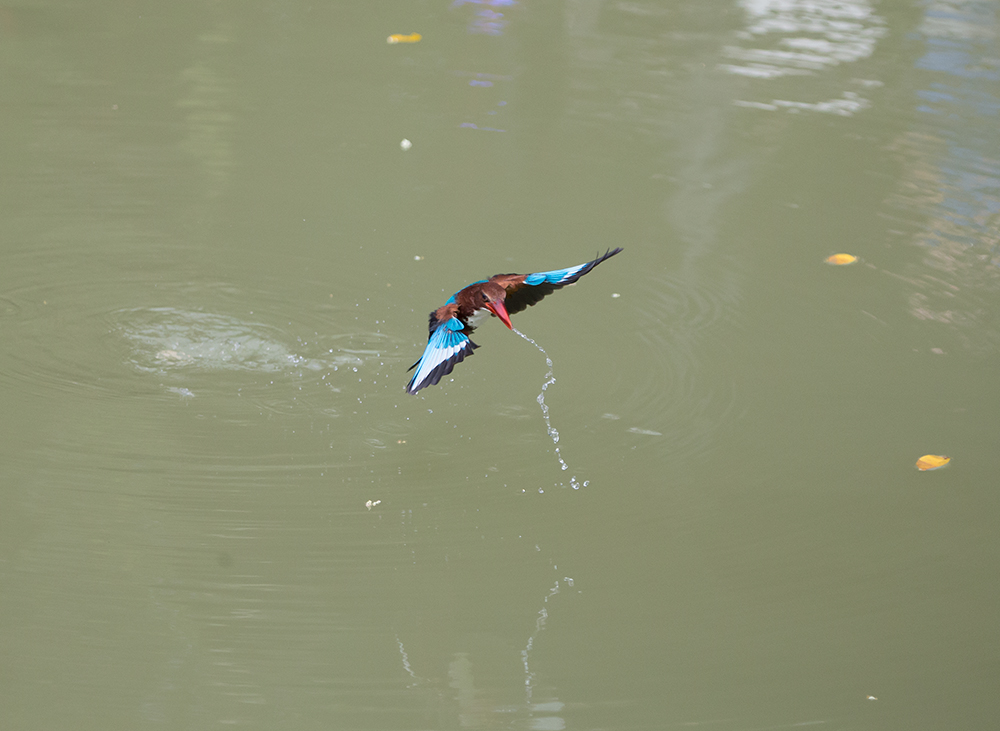
At the Symphony Lake, I picked up a nice White-throated Kingfisher.

I birded for one more hour adding Hill Myna, Greater Racket-tailed Drongo, Black-naped Oriole, Crimson Sunbird, Asian Palm Swift, Edible-nest Swiftlet and Asian Glossy Starling to my Singapore list! The heat and humidity put a stop to play at lunchtime but it was still a very nice way to round off the year's birding!
It wasn't a birding trip so most of what I saw was from the pool-side at our hotel in Phuket and around the hotel gardens. I managed the easy stuff......Brahminy Kite, White-bellied Sea Eagle, Peregrine Falcon, Chinese Pond Heron, Yellow-vented Bulbul, Spotted Dove, Olive-backed Sunbird, Tree Sparrow, Little Egret, Common Myna and Germain's Swiftlet. When the morning would heat up the soaring kettles of Asian Openbills were impressive.
At sea, it was disappointing birdwise, a few distant Tropicbirds and what I think were Bridled Terns in the straits of Malacca - but they were distant and the amount of plastic flotsam and jetsam floating on the ocean was depressing!
In Singapore I managed to fit in a day at the Botanic Gardens. I joined the Singapore Birders Facebook page and got useful advise from there about birding the Botanic Gardens. The best advise was to start early, before the crowds and before the heat. I took the MRT (Singapore underground) from our hotel at Clarke's Quay to the front gates of the Gardens, I arrived just as the sun was rising.
First bird was Scarlet-backed Flowerpecker, followed by the ubiquitous Red Junglefowl and Common Myna.
 | ||
| Cocka-doddle-do. Red Junglefowl |
 |
| Common Myna |
I strolled around Eco Lake where I had Common Flameback and Oriental Magpie Robin.

 |
| Oriental Magpie Robin |
 |
| Yellow Bitterm - Singapore Botanic Gardens - 31 December 2019 |
The Gardens are huge and I didn't want to spend all my time in the one place. I decided to try and walk to some of the other lakes and stop where ever I saw some nice habitat.
I found a quiet little shady glade where I chanced upon a very obliging Asian Brown Flycatcher. Again, as a UK based birder this is a species of interest to me.


 |
| Asian Brown Flycatcher - Singapore Botanic Gardens - 31 December 2019 |
 |
| White-throated Kingfisher |
Subscribe to:
Posts (Atom)