Sunday, 7 July 2013

Swallowtails makes the summer

You couldn't really call this the summer doldrums could you, possible Grey-necked Bunting at Blakeney (I was even ready to twitch that one!), an unconfirmed report of a Great Black-headed Gull at Titchwell, the Bridled tern in Northumberland and an Ascension Frigatebird in Scotland. They all generated plenty of discussions at least, if nothing else.
I built my birding around sport this weekend. The 3rd Lions test in Sydney on Saturday morning and the Wimbledon Men's Singles Final on Sunday afternoon. Thankfully both results went the right way.
On Saturday evening I decided to drive up to Kelling Heath and take a look for Dartford Warbler. I've never seen one, a very rare bird in Ireland, probably due to their sedentary nature. I'm guessing around ten records but I could be wrong there.
Anyway, after a bit of driving around I eventually found the right spot on Kelling Heath between the charming villages of Holt and Weybourne. I parked up and set off looking for the birds. The habitat is beautiful, dry heath with gorze, heather and bracken. Good for Nightjar, Woodlark, possibly Tree Pipit and of course Dartford Warbler. I saw none of these! The best I had was a recently fledged Nightingale, but on such a warm evening it was a fine place to stroll around. I may need to venture out of the county to Dunwich Heath in Suffolk for my Dartfords.
On Sunday morning Nick and I elected to stay reasonably close to Norwich. We parked up behind the train station at Buckenham Marshes. As with yesterday evening at Kelling Heath, there were Blackcaps, Whitethroats and Chiffchaffs all in song. We walked to the first hide where Nick picked up a nice Yellow Wagtail. However, apart from some juvenile Shelduck, Lapwing and Black-headed Gulls, there was little else there. We walked along the river bank towards the second scrape, it was only 9.45am but it was already getting hot. The Lepidotera and Odonata were out in force. I'm not good on either group but plenty of Small Tortoiseshells, Ringlets, Meadow Browns and one or two Red Admiral. Also, plenty of dragonflys, none of which I can identify. Nick tells me this is a Norfolk Hawker.


Norfolk Hawker, Buckenham Marshes RSPB - 7th July 2013

At the second scrape we had three Ruff, two Avocet (with chick) and several Redshank. With little else to detain us we decided to head back towards Strumpshaw Fen to look for the famous Swallowtail Butterflys. I say famous, because I've checked several times for them there without success. But I've always been a little late in the evening and sometimes the weather hasn't been great. Today it was already 25oC by the time we reached the car park so certainly warm enough for them.
We walked around the meadow trail checking the ditches. Plenty of Damselflys and Dragonflys but no Swallowtails. This one is a Four-spotted Chaser (correct me if I'm wrong).

Four-spotted Chaser, Strumpshaw Fen RSPB - 7th July 2013
Seriously though, on close examination they are fine beasts and I think its time to smarten myself up on Britain's Odonata and Lepidoptera, time to shell out on some books maybe! Any recommendations??
We also had this rather bleached and late Brimstone, typically an early spring butterfly, would this be the offspring of one that emerged in April??

Brimstone, Strumpshaw Fen RSPB - 7th July 2013
As we walked towards the fen hide we finally caught up with a single Swallowtail, it was a little distant though so we elected to head towards the famous private garden on the opposite side of the reserve.
We walked up the lane from the road and as we neared the garden I could see several photographers taking snaps of a something on the flowers. It was looking good and as we got close we could see one Swallowtail busy nectaring on the Buddleias. There was a second further up the border also.
There was no need for a big lens for these things, they paid no attention to any of us and went about their business oblivious to people. With patience it was possible to get some nice shots as they rested briefly with their wings open.

Swallowtail, Strumpshaw Fen RSPB - 7th July 2013
I must compliment the owners of the garden, who are clearly lovers of Natural History, they have created a very nice border for the Swallowtails and are very happy to allow people to walk up along it and take photographs within several feet of their living room. I hope this is never abused or taken advantage of. I spoke to them briefly and they seem lovely people.

Photographing Swallowtails near Strumpshaw Fen

Every so often two Swallowtails would come into contact with each other. I don't know if it was two males fighting or a male chasing a female or what (I suspect the former). But a bit of ruck would kick off between them as one would try to chase another off a flower head. They usually ended up tussling on the grass before one would give up and fly off leaving the other one alone. Quite entertaining to watch, at one stage their aerial tussle was within inches of my head.

'Get orf my land' - dualing Swallowtails - 7th July 2013
To see some movie clips of them click here and here

I was as interested and entertained watching these insects as I have been by any bird I've seen this year. They are truly stunning. If you have to chance go and see them. One Swallowtail could really make a summer!
After about an hour, we had both gotten reasonable photos and great views, the day was really starting to get hot, we were thirsty and a bit weary. We decided it was time to call a halt and go watch the tennis.


Tuesday, 2 July 2013

Starts, Shanks and Jars

With Polina away for a few weeks I had some free time last weekend. I took it easy on Friday evening and was up in good time to watch the 2nd test between Australia and the Lions on Saturday morning. The Wallabies spoiled the party a little and its all down to the last match this Saturday in Sydney. With the rugby out of the way by lunchtime, I pulled together a packed lunch and decided to head birding for the rest of the day.
I returned to East Wretham Heath to see how the Redstart situation was looking. Earlier on in the month there were a least two if not three male birds singing in the same general area and I had brief views of a female. This time there was no singing but I did have views from the path of both a male and female bird collecting food and bringing it somewhere. So the signs are that one pair has breed at least and are feeding young. Both birds were very busy and difficult to see well even though the male is obviously very striking. I watched them for a while and took a couple of record shots from the path before deciding it was best to move on. When I look at some of the stunning shots on BirdGuides of male Redstarts taken in Powys and other spots in Wales, I wonder how they are able to manage. I'm guessing you'd need a hide and a liberal amount of meal worms to start with.


Male Common Redstart, East Wretham Heath, Norfolk - June 2013
Female Common Redstart, East Wretham Heath, Norfolk - June 2013
With still a little time on my hands I headed over to the far side of Norwich to Strumpshaw fen. I wanted to try for the Swallowtail butterflys but the weather clouded over and the winds picked up. There was no sign at the garden so I wandered back to the hide at reception where I had distant views of Cuckoo and Common Tern.
Sunday afternoon, Nick and I headed for Cley to see if there was any early wader passage. From after 5pm the light was behind the hides and we enjoyed about two hours of nice light before departing. It's early yet but there were about seven Ruff, one summer plumaged Spotted Redshank, twenty or so Black-tailed Godwits and several Little Ringed Plover (including one juvenile bird).

Little Ringed Plover, Cley, Norfolk - June 2013

Ruff, Cley, Norfolk - June 2013
Several summer plumaged Common Redshanks entertained us by posing on the fence posts.

Common Redshank, Cley, Norfolk - June 2013
There were plenty of Avocets around although less chicks than a few weeks ago, possibly because now they are starting to look more like adults (?) or because the local Marsh Harriers are doing a job. I don't know which but every time a Marsh Harrier came near the scrape, all hell would break loose and the poor bird would be chased and harried away by the Avocets.

Hitching a ride - an Avocet hassles a local Marsh Harrier at Cley.

Marsh Harrier is seen off the premises by six angry Avocets
A quieter moment - taken from the same hide at Cley in early June

Sunday evening - an Avocet feeds in front of the hide at Cley
On the way back from Cley to Norwich I discussed suitable spots for Nightjars with Nick. He suggested Kelling Heath or Holt Country Park.
So, yesterday evening after work, with very little breeze and a warm evening I headed back up that direction around 8.45pm to look for Nightjars.
I didn't have exact details, but managed to locate a likely looking area near Holt Country Park. I parked up, gathered my gear together and set off on foot. I reached an area of open heath with short trees and gorse bushes. I scanned across the area and could see another birder about five hundred yards on the opposite side of the heath scanning too, so I figured I was in the right area. Seconds later a stunning male European Nightjar came into view hawking moths as glided over the tops of the gorse. The time was about 9.40pm, the light was still reasonable and although the bird was about one hundred yards away it was still possible to see some detail on its plumage such as the white feathers at the base of the outer primaries and on the outer tail feathers. They really stood out in the gloom. It wasn't alone and across the heath a couple more had started churring. On a still night the sound really carried. It was way too dark for photos but I did make the following recording of a bird churring as I scanned across the heath. Sorry for all the movement in the movie but hopefully, if you turn the sound up on your PC, you'll get a feel for how things were.

Sound of churring Nightjar

Bitten alive by midges and very satisfied with my views, I left the area at around 10.10pm and drove back to Norwich. This evening its dull and windy so I think I made the right call to go yesterday.

Dusk near Holt, Norfolk

Back in the Garden County

On the weekend of the 21st June I was back over in Ireland for a short family visit. I traveled light (thanks to Mr. O'Leary.......£50 for one bag?!!), so brought only my bins and left my camera gear behind. Anyway, it was a family visit so I wasn't expecting to do much birding. Nonetheless I had a little time to kill on Sunday afternoon so I took off towards the garden county of Wicklow.
First stop was Glendalough, I try to visit here every year. Its one of the very few places in Ireland where breeding Wood Warbler may be found and a very outside chance of Common Redstart and or Pied Flycatcher. I've seen Wood Warbler there twice including great views two years ago of a singing male.


Singing Wood Warbler - Glendalough, June 2011
This year however there had been no reports so I visited in hope rather than any expectation. I checked the usual spots above the second lake and wandered up amongst the woods above Poulanass waterfall without any joy. Nonetheless, two Spotted Flycatchers were nice and a few Jays which look noticeably darker compared to their UK cousins which I have been seeing for the last few months around Norfolk.
From Glendalough I drove towards the Sally Gap and down into the Coronation Plantation. This is a good spot for Whinchat, Crossbill and Spotted Flycatcher. A walk around the bracken at the back of the Scot's Pines provided a pair of Whinchat, I was sorry I didn't have my camera as the male was reasonably close at one stage. However they were carrying food in their bills so assuming they were feeding young somewhere I left them to their business. In the Scot's Pines I had a single Spotted Flycatcher and a Common Whitethroat further up towards the main entrance. The Coronation Plantation is a very picturesque place to visit and is always part of my agenda during trips down to Wicklow in the late spring or early summer.


River Liffey at the Coronation Plantation, Co.Wicklow, June 2013
At this stage I should have gone home but reports of a singing Lesser Whitethroat at Kilcoole were too tempting. A good spring bird for Ireland and even better if in song.
I speed walked all the way along the path to the Sea Buckthorn at Kilcoole. I located the bird easily enough even though I don't believe I've ever one in song before. Not the most remarkable of tunes but interesting if you've never heard it before. The wind was quite strong so the bird remained hidden as it sang. It popped up several times for brief views after which I turned on my heels and headed back to the car. I was too short of time to call over to the wardens at the Little Tern colony, sorry Niall if you're reading this, next time I'll say hello.

Sea Buckthorn, Kilcoole, Co. Wicklow - June 2013
So a short visit to Ireland but Whinchat, Spotted Flycatcher, Little Tern and singing Lesser Whitethroat was good going in a single afternoon!

Sunday, 9 June 2013

Once more into Brecks

I took off today for a few hours to East Wretham Heath. After a late one last night I was a bit slow getting out of the blocks and it was lunchtime before I arrived there. I wasn't expecting that much, the weather was a bit breezy, slightly cold and overcast, if I was to have any chance of seeing something I needed to be there much earlier in the day but that was never going to happen.
From the car park I headed around the path in the opposite direction and went first to the spot where I had a male Redstart in late April. Nothing there sadly, just a singing Willow Warbler (unseen) and a couple of Mistle Thrushes. For the next hour and a half I walked around the reserve slowly, looking and listening. Plenty of singing Blackcaps (including one buried in a hawthorn in subsong that had me thinking Garden Warbler for a few minutes, until it raised it black head), a Yellowhammer pair, a few Green and GS Woodpeckers, Coal Tits, Great Tits and Robins. No sign of the Whinchat reported on Birdguides from Friday either. I decided to check the Wood Warbler spot, I know its been weeks since it was reported but on the off chance it was still in area. I was strolling along with my mind on greater things (like work next week), when a snatch of song broke my train of thought, I glanced to the top of a Hawthorn and saw a lovely male Common Redstart singing away. I'm not too familiar with their song, in fact it may even be the first time I've heard one sing. I've heard them call many times but not sing. Its quite an unobtrusive song and you could easily overlook it. Anyway, I quickly forgot what it was I had been thinking about and set about trying to get some shots. Without too much success. There was a female present also so I kept to the main path and let them get on with things. The good news is that in the time I spent in that area I would say there was at least two if not three males and at least one female. I managed one 'okayish' record shot of a male but otherwise had to be content to just look and listen. Superb birds as always and hope that they breed sucessfully.


Male Common Redstart, East Wretham Heath, Norfolk - 9th June 2013

Sunday, 2 June 2013

Birding in Morocco - part three

We surfaced at the slightly later time of 7am the next morning. We enjoyed an excellent breakfast and discussed our plans for the day ahead. One thing was for sure, yesterday would be a hard act to follow. We started the day's birding by checking the Tamarisks surrounding the Auberge. We had several more Western Olivaceous Warblers, I had a Southern Grey Shrike which was upsetting the House Sparrows considerably, another Rufous Bush Robin (not as showy this time) and a single  Melodious Warbler. Other than that things were a little quiet and quite windy so we decided to move on. We returned via the very dry and bumpy desert piste that ran for 14 kilometers to the main road. The surrounding area looked dry and bird-less but even in the odd stunned Tamarisk we found single Spotted Flycatchers and more Melodious Warblers, presumably late migrants. We also had a small group of three very ragged Brown-necked Ravens, not the prettiest birds but a tick nonetheless.
We stopped alongside a long stretch of dry vegetation and decided to check it for Desert Warbler. I left my gear in the car because the wind was blowing up a lot of very fine sand, I'm sure my camera would have loved that! We didn't see any Desert Warblers but did find a couple of Desert Larks and a single Hoopoe Lark so I was well happy with those two additions to the list.
From there we headed back through the town of Rissani, much easier to negotiate now that the rush hour was over. We stopped at the football stadium just before the bridge and began to check the row of large Tamarisks for Saharan Olivaceous Warblers (reiseri). Almost straight away we had at least one male singing, in addition to a pair going in and out of a nest.


Saharan Olivaceous Warbler, Rissani, Morocco - 25th May 2013
We spent about thirty minutes watching these birds and trying for photos (which was difficult), present in the same area were several Blue-cheeked Bee-eaters. As we climbed in the car to leave we spotted this very smart 'Morrocan' White Wagtail, this time it was much closer than the one Nick picked up the day before and we both got some respectable shots from the car.

'Morrocan' White Wagtail (subpersonata), Rissani, Morocco - 25th May 2013
As we tried to leave a pair of very handsome White-crowned Wheatears appeared on the wall of the football stadium. With both of us still in the car we were able to secure some more decent shots especially of the female as she gathered various 'bits' of stone and grassy material, presumably for a nest.


Female White-crowned Black Wheatear, Rissani, Morocco - 25th May 2103
It was another 'difficult to leave' spot, like many places in Morrocco, but we had a rendevous with a 'Pharoah' Eagle Owl and needed to be on our way.
Using the Gosney guide once more we arrived at the appointed place for the Eagle Owl. The map in the book shows it to be about a 2km walk from the road to the spot. In the midday heat with 10kg of gear it felt more like 3 or 4kms. Although there were plenty of faeces streaked ledges on the cliff face we couldn't find the Owl at all. We gave up and started to hike back. Within about 500 meters of the road we met with a local on a moped call Lahcen Ouacha. He offered to show us Eagle Owl, Lanner and Spotted Sandgrouse all within an hour. At first we were a little suspicious but Nick negotiated a good rate (100 Dirhams per bird with a 'no bird-no fee' caveat). We walked back to the car and followed him on his moped towards the Eagle Owl spot.

Lahcen Ouacha leads the way
We walked the last few hundred meters to the spot (turns out we weren't too far ourselves, another two or three hundred yards further along the cliff and we may have found it) and had scope views of 'Pharoah' Eagle Owl.

Roost spot for 'Pharoah' Eagle Owl
The bird was pretty well hidden, visible quite well with a scope but no good for photos. I'll crop the above shot so you can at least see the outline of the bird.

'Pharoah' Eagle Owl - just!
True to his word Lahcen delivered with scope views of a pristine Lanner Falcon followed by a short track across the desert where we watched a group of about ten Spotted Sandgrouse. I managed to approach one of the birds but the heat haze put paid to any decent shots.

Spotted Sandgrouse - near Rissani, Morocco - 25th May 2013

We paid Lahcen his fee and were on our way. Incidentally, if you are planning on visiting the area Lahcen's contact details are al-hassan82@hotmail.com / +212 671146336. He comes highly recommended as a guide.

Celebrating Lanner with Lahcen Ouacha
By now it was late afternoon. We were planning to stay that night in Ifrane so we could be within an hour of Fes for a very early flight the next morning. We needed to get going. We made good time to Ifrane going back over the mountain passes we had taken the day before, stopping only to watch a flyover Long-legged Buzzard. However we were still missing several of our target species. For me I really wanted to see Seebohm's Wheatear, so once the habitat began to look good it was 'eyes-peeled' time from the car. We passed a vegetation covered lake which had good numbers of Coot, one of them looked good for Red-knobbed Coot (based on a quick glance from a traveling car). We pulled in further up and got out. I was badly in need of a toilet break, so as Nick headed back to check the Coots I answered the call of nature. I was mid way through that call when a female Seebohm's Wheatear popped up on a rock right in front of me. Applying impressive sphincter control, I stopped 'mid-leak', picked up my camera and took a few shots. I'm not sure what people in passing cars thought of the scene though!


Female Seebohm's Wheatear
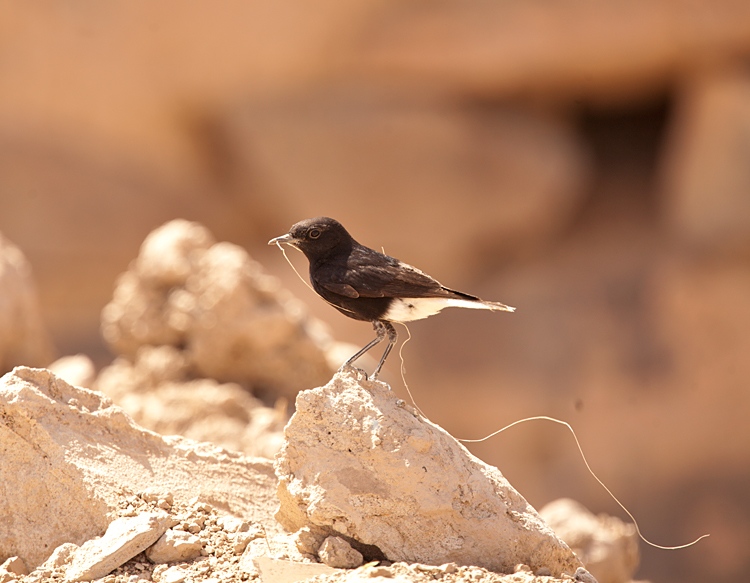
I could hear a male singing somewhere nearby and as the light faded I managed a shot of this fine male bird whilst it sang from a flat rock further up the path.

Male Seebohm's Wheatear
For me this was definitely one of the finest birds we'd seen all trip and while for the moment, it is still a version of Northern Wheatear I think it must become a separate species at some time in the near future.
I left the Wheatears for a moment and walked back along the road towards Nick so I could see the Red-knobbed Coots. Although I had seen the species in 2007 and 2011 at S'Albufera in Mallorca, they are introduced there. Here they are the real McCoy, so important for me to see them.


Red-knobbed Coot
Before we left, we watched a few singing Corn Buntings and Linnets in the same area. The light was almost gone, we returned to the car and drove the last hour to Ifrane where we overnighted at the La Chamonix Hotel. We had about four hours sleep before rising at 3.30am and hitting to road back to Fes for our 7am flight back to Stansted.

So, I hoped you've enjoyed this account of our short trip to Morocco. What a country for birding. Good infrastructure, good light, great birds and friendly people. We didn't see Dupont's Lark or Levaillant's Green Woodpecker but, if I needed one, there are now at least two reasons to return.


Saturday, 1 June 2013

Birding in Morocco - part two

After a decent night's sleep we were up and away by 5.45am. It felt cold so I threw on about four layers before heading out.
We were looking for Dupont's Lark and following the maps in David Gosney's book, we soon reached the spot on the Zeida Plain. It was 6am, the sun still hadn't risen just yet and it was very chilly. We could see small little brown shapes darting around the scrub and could hear some larks beginning to sing but no sign of any Dupont's. The first birds to show well though were a pair of Desert Wheatear. The last time I saw this species was in November 2011 on Bray Head in Wicklow, Ireland. I remember wondering at the time how would a desert species survive an Irish winter, but they seemed very happy there on that cold desert morning, so no problem to them. As the morning brightened up we could hear plenty of Lesser and Greater Short-toed Larks singing. We walked in separate directions looking and listening for Dupont's Larks. A party of three Ruddy Shelducks flew over and I had a single Trumpeter Finch alongside a Lesser Short-toed Lark. Nick soon called me over though when he picked up a lone Thick-billed Lark poking around the scrub. I tried for some record shots but the bird just seemed to vanish. Still an impressive species though.


First light on the Zeida Plains
We continued walking separate lines as the light gradually improved. I came across a smart male Red-rumped Wheatear and watched it as it perched and sang from the tops of bushes and rocks. However it never came close so it was record shot territory again.


Red-rumped Wheatear, Zeida Plains, Morocco - 24th May 2013
I took a short movie clip of it singing - click here to watch.

By 8.30am it was starting to really warm up, although we had dipped on Dupont's Lark, we had seen some decent species, several of them lifers for me. Before reaching the car we came across this rather approachable Thekla Lark. We both got shots before deciding that it was time for breakfast.


Thekla Lark - Zeida Plains, Morocco - 24th May 2103
Before getting back to the hotel we pulled over to check a line of high Papyrus along the road side for Western Olivaceous Warbler. No luck this time but we did have Reed Warbler, Serin, Woodchat Shrike and Turtle Dove. Quite a Spanish feel to things!
After breakfast we set off once again. This time we were headed for the Tizi-n-Tairhemt pass. Taking 'gen' from Josh Jones trip report, we were looking for an area where we might see Tristram's Warbler, a species I've longed to see. We parked at the hairpin bend and descended into down into the valley. 


Tristram's Warbler site
Carrying a tripod and heavy gear down a scree covered slope was precarious. At any moment I expected my feet to go from under me, I was more worried about smashing my gear up rather than breaking my arse on a sharp rock, is that normal? At the bottom, we walked the rocky edge of a dry river bed surrounded by stunned junipers trees. We could both hear the scratchy sound of a small Sylvia. Within a few minutes we managed to connect with an absolutely stunning male Tristram's Warbler. It was too busy to sit still for photos, so I had to contend with just watching it instead, but what a bird. But if that wasn't good enough, as I sat watching the Tristram's a couple of very striking male Moussier's Redstarts put in an appearance. One of them proved to be quite bold and sat up on the edge of juniper bush for enough time to get a decent snap.


Male Moussier's Redstart, Tizi-n-Tairhemt pass, Morocco - 24th May 2013
As we came back to car I couldn't decide which of the two species I liked more. I'm still undecided as I write. Before we left the location we had some nice views of a singing Serin, a single Coal Tit, a pair of Black Wheatears and a male Woodchat Shrike. It was a hard spot to leave.


Serin, Tizi-n-Tairhemt pass, Morocco - 24th May 2013 

We continued on through the mountains, as the river ran close to the roadside, Nick pulled over and said it might be worth checking the stream for Moroccan Wagtail ('Subpersonata' White Wagtail). It turned out to be a good call, as soon as we had started to scan the gravel edges of the river we picked up a pair feeding some young. The male is a very striking bird indeed, so well worth seeing. Present also were a pair of Grey Wagtails, these too were feeding young.
As we descending the mountain pass the countryside began to green up a bit. We stopped  when we noticed a Hoopoe flying into a nice looking roadside orchard. Both of us felt it might be good for Western Olivaceous Warbler, and at the far end of the orchard we were in luck. A single bird was singing from deep cover. 


A nice looking orchard - with Western Olivaceous Warbler buried in there somewhere
Getting good views were tricky, I stared into the bushes with my bins trying to get views of it as it moved from branch to branch. At one stage I thought I had it as it sat still on a low branch, but I soon realised I was staring straight at a Nightingale instead. Not bad I guess, but Western Olly was what I really wanted to see. As Nick moved around the other side of the orchard, I stayed put and eventually my quarry came to the edge of a tree and began to sing. You could say these are relatively non-descript birds, but not for me. The slim elegant body shape, the long bill and sloping head shape, I had soon forgot about Moussier's Redstart and Tristram's, Warbler. Western Olivaceous Warbler was the new star and I was now really looking forward to catching up with Eastern (pallida) and Saharan (reiseri) forms.


Western Olivaceous Warbler
With time pressing we continued on. By about 4pm we arrived at a very nice lush looking wadi outside the town of Errachidia. I followed the sound of a singing Western Olivaceous Warbler. It was high above me in a Tamarisk but from there I could see the swollen convex sides of its large bill as well as hearing its song well. After watching it for ten minutes or so I continued on and a short distance ahead I came across another Olivaceous Warbler. This one was silent though and as it flew from one tree to another I could see its bill looked noticeably shorter and it dipped its tail down repeatedly as it moved through the Tamarisk, so possibly an Eastern Olivaceous Warbler this time. Just then Nick texted me to say he had a pair or White-crowned Wheatears, I caught up with him and we both watched the pair going in and out of nest hole under a large rock. Meanwhile a couple of Blue-cheeked Bee-eaters hawked insects overhead. In a small Tamarisk a rather yellow looking warbler was moving. On first views it appeared to have a pale panel on the wing. We had both thought Melodious so this threw us for a bit. But Nick had seen a short primary projection and I recalled something somewhere about fresh Melodious Warblers having a pale wing panel. I haven't seen that many Melodious Warblers but have seen plenty of Icterines over the last two summers in Latvia and the head shape looked different too, more rounded than Icterine. Plus I don't think Icterines migrate this far west in spring.
As we came around the edge of a large Tamarisk I almost stood on this very showy Rufous Bush Robin. I thought it would fly when I set up the tripod but it was a real poser and gave both myself and Nick the best show any bird had put on so far. At one stage it was too close to even focus on. There's a record of one from Cape Clear in the 1960's, can you imagine the stampede if another turned up this autumn. For ten minutes or so I forgot all about Eastern and Western Olivaceous Warblers while this little cracker put on a show.


Rufous Bush Robin, near Errachidia, Morocco, 24th May 2013

To see a short movie clip click here


As usual time was pressing on and we had one more target to aim for. Outside the town of Rissani, on the road to Merzouga, is a well known site for Egyptian Nightjar.
We hit Rissani at rush-hour (honestly, it was mayhem). We followed the maps on David Gosney's guide but managed to get a little lost, once again our dodgy french was used on some poor gendarme and we were soon on the right track. Just beyond the Auberge Tresor we pulled over and got our gear out. The sun was dipping, the moon was up and we walked the dry desert piste looking and listening for 'jars. We wondered how they must roost in the direct desert sunlight and Nick mentioned that they must try to find the shade of a small acacia bush. We took separate paths and pretty soon Nick was out of sight. I walked along a dry wadi where short stunned acacias spread out in a line in front of me. Every five yards or so I would stop and scan the acacias for twenty yards in front of me looking for a roosting bird. After twenty minutes I had drawn a blank and was running out of acacias to check. Just then I noticed an interesting shape sitting under an acacia about twenty yards in front of me. I quietly set my tripod and camera up, pulled a couple of shots and as I cropped them on the viewfinder I could see it was roosting Egyptian Nightjar. I texted Nick to say I had a roosting bird and he appeared from a ridge about five hundred yards in front of me. I waved to him and pointed in front of me, he had joined within five minutes. We stayed for about twenty minutes watching the bird. Just as the light was almost gone it suddenly got up and flew off into the gathering gloom. What a bird, if you weren't looking for it you would walk right past it such is its plumage.


Egyptian Nightjar roosting near Rissani, Morocco - 24th May 2013
Here's the above image cropped.

Egyptian Nightjar
By now it had been quite a long day. We made our way to the Auberge Yasmina where we planned to overnight. A delicious Moroccan meal and a couple of cold beers rounded off one of the best days of birding I'd had in a long time.
More tomorrow!