Tuesday, 18 December 2012

The twelve birds of Christmas - part one

Each day for the next six days I will be posting two of my own favourite bird photographs taken during 2012.
They're in no particular order, just a random selection of my favourite shots with a short description and some technical blurb added for good measure.

The first bird

I'll start with one I took out on Ardmore Head last March. I had headed out to Co. Waterford to see an early Woodchat Shrike found by Daniel Weldon (I think) along the Goat Island Road. The bird was gone so I decided to walk Ardmore Head and this fine male Reed Bunting was singing from some brambles in full view. A reminder not to disregard the everyday stuff!

Reed Bunting, Ardmore Head, Co. Waterford

Taken with Canon 5D Mark II, Canon EF 500mm f4 IS, ISO200, f4, 1/600 sec using tripod

The second bird

Today's second bird is a first winter / female type Pied Flycatcher. Taken along Hurley's Lane on Knockadoon Head. This bird was part of a significant movement of the species that took place over a few days across both the UK and Ireland in late August. It seemed at the time to herald the start of the autumn migration but little else followed in what was one of the most disappointing autumns in Cork for a long time.


Pied Flycatcher, Hurley's Lane, Knockadoon Head, Cork
Focal length - 700mm,  aperture - f7.1, ISO400, shutter speed - 1/500 sec and handheld (well, resting on the car roof to be exact).

More tomorrow!

Sunday, 16 December 2012

Bird of the Year

2012 was, for me anyway, a less than vintage birding year. When the good stuff such as Baillon's Crake and Red-flanked Bluetail turned up in spring I was stuck in work, autumn in Cork was one of the poorest on record for scarce and rare vagrants and all in all I must have dipped or failed to connect with at least twenty target species during the year.
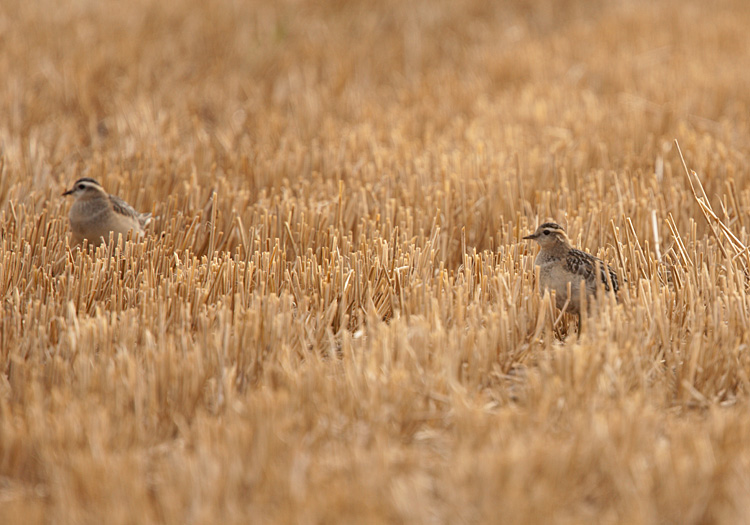
Picking out a 'Bird of the Year' would seem like selecting a 'Man of the the Match' from a rain-soaked nil all draw. But there is one bird that does stand out from 2012. Well, actually two to be precise. The pair of Dotterel that Dara Fitzpatrick found near Robert's Cove, County Cork, Ireland gets my vote as 'Bird of the Year'.
It was early October and I had spent the day bush-whacking around Knockadoon Head for migrants. The best bird had been Spotted Flycatcher and so with little to show I decided to round the day off at Kennedy Pier, Cobh hoping to see the returning Sabine's Gull.
I received a call from Dara Fitzpatrick who told me he had found a pair of Dotterel in a stubble field right at the end of the headland past Robert's Cove. With no sign of the Sabine's Gull I made a quick decision to drive the forty minutes over to see the Dotterel pair.
Myself, Dara and Seanie Bourke tracked out along the headland as the sun began to lower. By the time we reached the field where the birds were the sun was just minutes from dropping behind the hills. We scanned the stubble field as a Hen Harrier quartered the ditch at the far end. It didn't take too long to pick out these two little heads poking up out of the cut corn. Lifers for all three of us, we took scope views first before beginning to move a little closer.


Dotterel - Robert's Cove, Co. Cork, Ireland - 6th October 2012

Once Seanie and Dara had 'filled their boots' I began to approach for some shots. The birds were remarkably tame although it was tricky to get an unobstructed shot as they fed amongst the corn stalks. Within about twenty feet they would grow wary and begin to walk away, so that was close enough. At that distant they looked truly stunning, a striking pale supercilium that meets at the back of the head, both busy feeding on insects about five or six feet apart but regularily calling to each other.


Dotterel, Robert's Cove, Cork, Ireland - 6th October 2012
Satisfied with my views and shots we left the birds happily feeding away in the field. The next day they had moved on.
Dotterel are not exceptionally rare in Ireland, they're not a breeding bird but occur during both spring and autumn migration. However their preference for high mountains plateaus or large open stubble fields means that they are probably overlooked or pass through unseen.
To finally connect with the species and to do so in such subtle light and with two very confiding individuals makes them my 'Bird of the Year'!

Thursday, 13 December 2012

Wild goose chase

I was up in the north-west for a couple of days specifically Co. Sligo. Not for the purposes of birding but I threw my gear into the car all the same..........y'know......just in case!
Anyway, with about two hours to spare I drove out of Sligo town towards Raghly with two targets in mind. One was Twite and the other was Cackling Goose.
Local knowledge told me that they weren't any Twite present so far this year at Raghly Pier and that turned out to be correct. I checked briefly, apart from a single Rock Pipit and a small flock of Brent Geese, Raghly was birdless.
I got good 'gen' from Birdwatch Sligo on the where to find the Barnacle Geese. I drove the back roads behind Yellow Strand and soon located a small flock of Barnacles in one of the fields. I parked up and got the scope out. It was only as I scanned the fields I realised just how many geese there actually were. Evidently the flock is four thousand strong at this stage! A really impressive sight and sound........proper winter birding! However, picking out the Cackling Geese from that lot proved far more difficult than I expected. I was facing into the wind first of all, so my eyes were streaming as I peered through the scope. Plus, the birds  move around a lot, disappearing behind tussocks and ditches and many had their heads tucked in as they slept. I'm making excuses but the upshot of it all is that I didn't see any Cackling Geese sadly. Time ran out and I needed to make tracks, Lissadell to Cork City is a long drive. But........it was worth it just to see all those Barnacles, a wonderful sight for any nature lover. I would have loved to have spent longer, the fields were full of Northern Lapwing, Fieldfares and Chaffinches.......must be a few Bramleys in there also.
On the road back to Cork I stopped between Tobercurry and Curry village to check out this small flock of Whoopers in a field. Three juveniles and four adults. They eyed me carefully as I pointed my camoflage covered lens at them!

Three juvenile Whooper Swans and one adult, Co. Sligo - 13th December 2012

Adult Whooper Swans, Co. Sligo - 13th December 2012
My thanks again to Birdwatch Sligo for the 'gen' on both Twite and Cackling Geese. I dipped on both but enjoyed my brief taste of Sligo birding.                                                                                            

Wednesday, 12 December 2012

Is fearr liom 'Winter Birding'

What's all the fuss about autumn birding? We wait all year for October and in the meantime forget to enjoy that which is right under our noses.
I had forgotten how good winter birding can be until I took a two hour jaunt around Great Island yesterday. Normally I bird Great Island quite often in the winter months as prep for the January bird race. This year however I'll be over in Norfolk by then so no race for me. But it's still worth spending some time there all the same.
I headed first for Kennedy Pier in the town centre. Even as I crossed the main street I could pick out the distinctive wing pattern of the Sabine's Gull as it cavorted with the Black-headed Gulls off the end of the pier. I turned quickly on my heels and headed back to the car for my camera gear but by the time I got back it had ventured over to Haulbowline Island on the opposite side of the harbour. I had also forgotten to bring gloves and a hat with me, with a cutting wind coming straight in off the sea my fingers were numb in minutes. I could barely depress the autofocus / shutter button and so I forgot about any photos and contented myself instead with just watching the bird each time it came alongside the pier. The grey, white and black tricolour wing pattern is so striking that I don't think I will ever tire of watching this bird.
As I left the pier I noticed the familiar anchor-shaped silhouette of one of the Cobh cathedral Peregrines as it drifted over the town centre before alighting atop one of the gargoyles.
I warmed my frozen fingers up with a coffee from Supermacs (classy eh?) and then set about trying to locate the Waxwing flock that had been frequenting the berry bushes near Colaiste Mhuire. Unfortunately my timing was a little off, it was 1pm and all the school kids were milling out of the gates on lunchbreak. I thought better of sitting parked opposite the school gates peering through a pair of bins. In any case I've done pretty well so far on the Waxwing front but wouldn't mind them as a Cork tick.
From there I pushed on to Cuskinny Reserve. Nothing much out at sea and a nice wave of salt water crashing over my car at the harbourside car park told me I'd be better checking out the lake instead.
As soon as I pulled in over at the lake, all the gulls got up and flew over towards me. Obviously very used to be being given bread. I let them settle and picked up a single adult winter Ring-billed Gull amongst all the Black-headed Gulls.


Adult winter Ring-billed Gull - Cuskinny Reserve, Great Island, Cork - 11th December 2012
Today there was no sign of any Buzzards but a flock of Wigeon bobbed about on the far side of the lake as I chucked bread to the ravenous gulls.
I checked the woods at the back of Cuskinny for Redpolls or Siskins but it was quiet there. From Cuskinny I drove towards Rossleague where the road tracks close to the channel that runs between the north side of Great Island and Rossmore on the opposite side. I've seen Slavonian and Pied-billed Grebe in that channel but today there were just Little Grebe (albeit in good numbers), Great-crested Grebe and Red-breasted Mergansers.
I checked for finch flocks and winter thrushes along the way. Not far from the Oyster farm I found a sizeable flock of Chaffinches but despite careful scrutiny I couldn't see any pale-rumped Bramblings. As well as mixed flocks of Blackbirds, Redwings and Song Thrushes I caught a brief sight of a Treecreeper and could here a Yellowhammer calling from somewhere but couldn't pin it down.
A large juvenile looking Peregrine put up all the Wood Pigeons and Corvids that were feeding on the stubble fields and from over by the pinewoods I could hear the mewing call of a Buzzard. Eventually I picked up the bird perched high in a tree on the edge of the woodland.
As darkness fell I headed home to spike some fresh apples for the Blackcaps that are feeding around our apartment grounds.
Winter birding......now you're talking!!

Thursday, 6 December 2012

Norwich's Birding Barber

We've been house-hunting in Norwich for the last few days. Seems a very nice city and I reckon we will both be very hapy living here.
This morning I popped out for a quick haircut. The first thing I noticed when I sat down in the barbers was a Kowa scope set up in the corner. I had to ask of course, and the barber explained that a regular customer had lent it to them so they and other customers could watch the Peregrines on Norwich Cathedral.

BBC news article - Norwich Cathedral Peregrines

I'm looking to pick up a secondhand Kowa TSN821 and, as it happens, that was just the type of scope it was. There was no sign this morning of the Peregrines but the image quality through the scope was good, so I may invest.

Birding barbers in Norwich
I think its a good omen, reckon I'll be quite happy in Norwich and I'll keep an eye myself on the Cathedral falcons.

Monday, 3 December 2012

More Waxwings and three year ticks

Sunday was a much duller and wetter day than Saturday had been, but I still wanted to get out. I headed east to county Waterford intending to catch up with the Surf Scoter.
Driving over the mountains between Youghal and Dungarvan the cloud hung low and the drizzle was persistant. Things weren't much better as I descended into Dungarvan. For some reason I had kind of expected the Scoter to be viewable from the first roundabout opposite the GSK plant but I realised that was wrong when I looked there. I called Michael Cowming and he gave me directions over to Abbeyside church where the bird was on show between the lookout point and the tip of the Cunnigar.
Apparently just before I had arrived it had been 'really close', for me though it had swum over to the Cunnigar tip and remained there for most of the afternoon. I watched it for a while hoping that it might drift back but never happened. Still though the views were as good as I've ever had of this species. Only the third time I've seen one too.

Surf Scoter, Dungarvan, Co. Waterford - 2nd December 2012
Interesting also to watch it feed, as the diving action of Surf Scoter is distinct from the that of Velvet and Common Scoter, therefore being a useful ID feature. The bird dives with a small leap, flicking open its wings just as it disappears. Common Scoters hold their wings tight against their body as they dive and Velvet Scoters sort of slink into the water with open wings and no dive (see p.40 of the 2nd edition Collins Guide for some excellent diagrams).

Surf Scoter diving action - a leap with wings flicked open
The Surfie wasn't the only bird there though. Three distant Long-tailed Ducks were a year tick for me. There were several small groups of Brent Geese present, feeding mainly along the shore, good numbers of Red-breasted Mergansers and Great-crested Grebes and a few Great Northern Divers.

Winter plumage Great Crested Grebe

Fishing just off the Cunnigar tip - Great Northern Diver
Two Brent Geese take flight with female Red-breasted Merganser in the background
After about thirty minutes I got a text from Michael Cowming that he had a flock of Waxwings near the Campus garage on the N25. With the Surfie remaining on the opposite shore I decided to check the Waxwings out. However by the time I arrived they had dispersed and the best view I got was of a single bird perched high in tree somewhere within a housing estate off the N25. I drove around for fifteen minutes or so but just couldn't find the flock.
As I ate my lunch I decided to head back to Abbeyside and see if the Surfie had changed his mind and swum a little closer.
No such luck as I got there but to be honest having only see two Surf Scoters beforehand ever and about the same number of Long-tailed Ducks I was content to just watch the birds through my scope.
Michael arrived after about twenty minutes and told me that Colum Flynn had found a male Common Eider over on the eastern side of Clonea Strand. Again not a bird I've seen too often in Ireland so I took directions from Michael and headed off to find the bird.
It was one of those funny things. I found the spot Michael had described to me. I thought that seeing the bird would be a formality. After all, male Eiders are big bright looking things, even at a distance they tend to stand out. However I must have spent twenty minutes scanning the sea with my scope but had nothing. With evening pushing on I packed up my gear and got ready to head back to Cork. But I just couldn't accept that the bird wasn't in the area where Michael had described. I started up the car engine and couldn't resist one final glance through my bins, and there it was! About one hundred meters off-shore (and as I was about the same distance from the shore itself, that made it too far for even a record shot). But still a fine looking bird all the same.
With three year ticks under my belt I headed back to Dungarvan for one final check around the Campus garage for the Waxers.
This time they played ball. Driving back up the N25 towards the garage I spotted them perched confidently in a tree. There was already a couple of non-birders taking some shots of the flock (great to see that, maybe the sight of a Waxwing flock will be the spark for some budding birders out there).
I pulled in on the hard shoulder, got my gear out and managed a few shots in the gathering gloom (it had gone 4pm by now).
The birds dropped from their tree perch at one stage to feed on the cotoneaster berries which lined the footpath. I had to duck as they flew past within inches of my head. It was a real pity the light was so low but I picked off a couple of records shots before calling it a day.


Waxwings, Dungarvan, Co. Waterford
My thanks to Michael Cowming for keeping me updated all afternoon with 'gen'. It's always a pleasure to bird in Co. Waterford.

Saturday, 1 December 2012

Sabine's Gull still present

Today, Saturday, was crisp and bright. With duller and wetter weather forecast for tomorrow I decided to head out for a few hours around 11am. I was tempted to head for the Surf Scoter over at Dungarvan but opted instead to keep it local. Ronan McLaughlin had reported a Black Red from Cobh earlier in the week so I decided to have a look around the seafront for that.
However I spent over half an hour chatting to an old work colleague on the main street in Cobh so didn't really concentrate too hard on looking for any birds. No sign of the House Crow, which I don't think has been seen in quite some months, and certainly no sign of any Black Reds.
Over at the pilot boat camber, all was quiet with just the usual stuff knocking about. On the harbour side of Cuskinny all I had were Common and Black-headed Gulls. I checked the harbour further out for divers and grebes but again my scope just doesn't do it. I own a Kowa TSN661, not a bad scope but limited reach and the object lens is badly scuffed so its a bit like looking through grease-proof paper sometimes. I'm on the lookout for a decent secondhand scope at the moment. Anyway, I couldn't see anything out in the harbour so swung around to Cuskinny Lake itself. It was about 1.50pm and I wanted to get back and watch Wales v. Australia and England v. New Zealand in the rugby, kick-off 2.30pm so this was going to be a quick check of the lake.
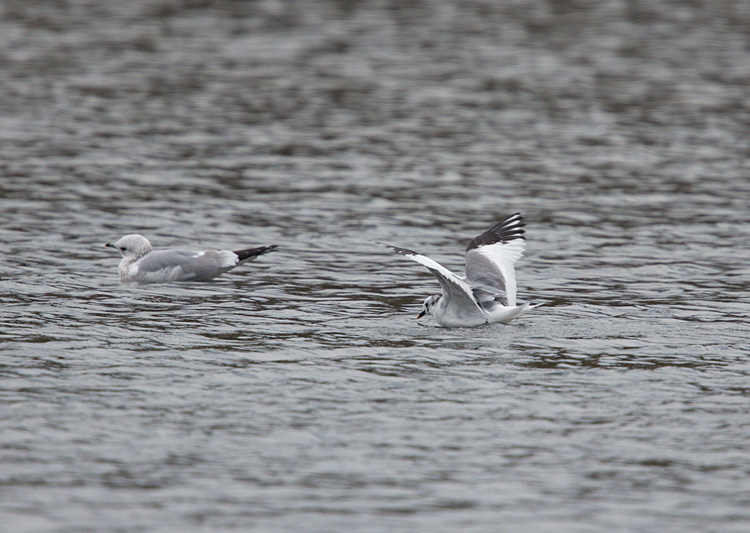
I scanned the birds once and on my second sweep I just got sight of the tricoloured wing pattern of the Cobh Sabine's Gull as it landed amongst a few Common Gulls and began to wash. Great stuff, I have a particularily soft spot for this bird, good to know its still around and doing well.
It joined in with the Common Gulls present and I watched them all wash up for about fifteen minutes. Once it was finished it didn't wait around for the Common Gulls. It upped by itself and went back out into the harbour. Was that my last encounter with this bird??

Sabine's Gull with Common Gull, Cuskinny Reserve, Great Island, Cork - 1st December 2012

Having a thorough wash!
A few pairs of Gadwall were still present, this males was getting a bit of agro from the Mallards.

Male Gadwall - Cuskinny Reserve, Great Island, Cork - 1st December 2012
On the far side of the lake was a small flock of about twenty Wigeon, present also were approximately six Little Grebe and the usual Mallards, Mute Swans, Moorhen, Black-headed and Common Gulls. No Ring-billed Gulls this time.
I headed home to watch the sport and picked up a message on FB from Ronan that the Waxwings have arrived in Cobh...........something to aim for tomorrow maybe!