Sunday, 8 April 2018

Western Sahara - part two

We decided we should get Royal Tern out of the way first so the next morning we headed northwards out of Dahkla reaching a beachfrount resort called 'Dahkla Attitude' where we figured we might get some resting Terns on the beach as high tide approached. In short, that never happened but we did have some good birds from the carpark of the beach resort that morning. Top-billing was this Lanner that swooped in a snatched an unfortunate House Sparrow and then sat on the sand enjoying it's mid-morning snack.

Lanner - Dahkla Bay, 29th March 2018
The local birds around the carpark were also pretty good too!

Male Black Wheatear - the female was never too far away

Thekla Lark - ever present around buildings and human habitation!
And what was to become one of the most numerous migrants during the course of the week - Western Subalpine Warbler.

Male Western Subalpine Warbler

Male Western Subalpine Warbler
Another Grasshopper Warbler was present plus several Chiffchaffs.
From there we continued along the road out of Dahkla passing through the main check-point along the way. We checked a site for Scrub Warbler which didn't have any Scrub Warbler but did surprisingly have this Short-eared Owl.

Short-eared Owl - a notable record for Western Sahara??
We stopped off at another wadi along the road that looked promising for migrants and in here we really had a good couple of hours. I flushed what turned out to be a Scops Owl (a two Owl day in WS!)

Otus Scops!
We also had wonderful views of singing Desert Wheatear.

Desert Wheatear
Also present in this area were Great Grey Shrike (elegans) and I believe I had a small flock of Temminck's Larks but regretfully I never managed to catch up with them later on.
From there we moved on to the 'famous' water tower at Tachaktant. This is a just a small area with a water tower, some pools (puddles really), Tamarisks and other scrubby desert bushes but we visited several times during our trip here and it always had plenty of great birds.

The wonderful water tower at Tachaktant - a migrant magnet

On that first visit we had Green Sandpiper, Little Ringed Plover, Spotted Crake and Greenshank mooching around the puddles. On the passerine migrant front we had several Bluethroats, more Tree Pipits, Yellow Wagtail, Wryneck, Sedge and Reed Warblers and plenty of Willows and Chiffs.

Bluethroat

 Yellow Wagtail

 Yellow Wagtail

 Yellow Wagtail

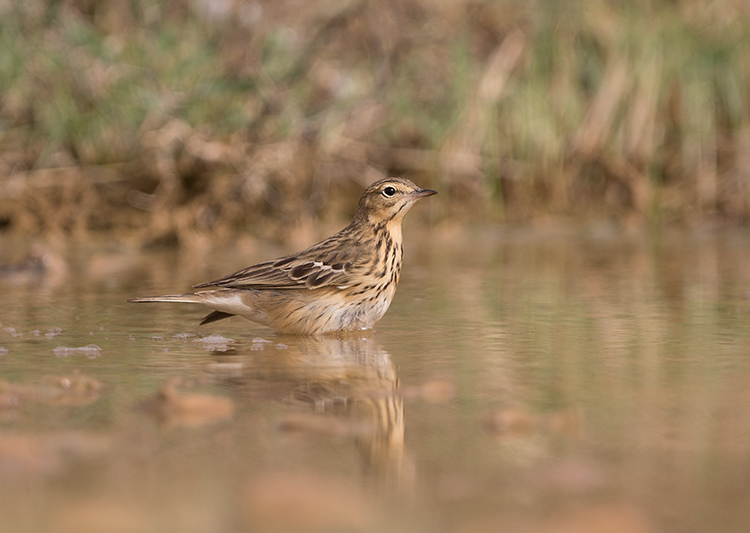
Bathing Tree Pipit

Bathing Tree Pipit
It was here also that we bumped into a group of four Dutch birders that we were to cross-paths with frequently over the next few days. It was very useful to share information with them as it turned out. They gave us some 'gen' for Royal Terns back at Dahkla so with our 'boots filled' at the water tower spot we decided to give that a go. We drove back to Dahkla and checked the cliff edges along by the 22 km marker on the road. However, Royal Tern frustratingly eluded us yet again but we did have a Black-crowned Night Heron and two Western Bonelli's Warblers moving along the cliff edge.

Black-crowned Night Heron


Western Bonelli's Warbler
Then it was time for dinner and bed!

Western Sahara - part one

On Tuesday 27th March myself and Nick Watmough headed to Western Sahara for a week long birding trip. We based ourself in the city of Dahkla for the first two days, birding off our own steam at various spots around the city and Dahkla Bay itself before spending three days in the desert looking for specialist species such as Golden Nightjar, Cricket Warbler and Sudan Golden Sparrow amongst many others.
We had a long but uneventful journey from Gatwick airport to Dahkla via Casablanca with Royal Air Maroc. We picked up our rental car on arrival at Dahkla, drove to the hotel and hit the hay pretty much immediately.
The next morning we fuelled the car up, picked up supplies for breakfast and lunch (fresh bread, water and camel cheese) and set off birding.

Breakfast and lunch - bread and camel cheese
First birds were Common Swift and Osprey. We birded the coast road on the Atlantic side where we had gatherings of 'Intermedius' Lesser Blacked-back Gulls, Audouin's Gulls, a few Yellow-legged Gulls and the odd Caspian Tern mixed in. We were hoping / expecting to come across a few Royal Terns but this species was to prove quite tricky for us over the course of the week. We also had several Kentish Plovers along the track plus a single Common Sandpiper and a pair of Hoopoe Larks. Migrants were also in evidence with the occasional Northern Wheatear popping up.

Adult Audouin's Gull


Caspian Terns

Hoopoe Lark
We reached the end of the track and in attempting to turn back we got stuck in the sand - however a few locals and a couple of Gendarmes were on hand to push us out. But, from that point on I was a lot more cautious going off road - it doesn't take too much sand to stop you in your tracks if you don't have 4-wheel drive.
From there we located a small little lagoon on the bay side of the main road heading north out of Dahkla. We had quite a nice combination of waders and migrants in this spot. We had Grey Plover, Collared Pratincole, Redshank, Greenshank and Whimbrel and on the migrant side we had Bluethroat, Grasshopper Warbler, Tree Pipit, Subalpine Warbler, Chiffchaff, White Wagtail, Sand Martin, Blue-headed Wagtail and Marsh Harrier.
Continuing our quest for Royal Terns we headed further along the north road out of Dahkla. We scoped this group of Terns and Gulls for Royals and while there were none present, the Slender-billed Gulls were really elegant looking.

Slender-billed Gulls (plus Sandwich Terns and Black-headed Gulls)
We stopped for lunch in a little cafe at a spot called L'aquila. The owner had planted a few trees around the edge of the cafe and even these held a few migrants that kept us entertained while we enjoyed our chicken sandwiches. We had Subalpine Warbler, Nightingale, Tree Pipit, Woodchat Shrike, Blackcap and Chiffchaffs. Basically any area of greenery in the desert will attract migrants!


L'aquila cafe - lots of cover for tired migrants
We headed back towards Dahkla and finished the day off at a small farm where we enjoyed the spectacle of at least 30+ Tree Pipits and many Blue-headed Wagtails plus lots of Chiffs and Willows (including some darkish looking Willows - acredula?), one more Nightingale, Hoopoe and Bee-eaters.

possible 'acredula' Willow Warbler?
Farm outside Dahkla (Taourta II on google maps)

Sunday, 18 March 2018

Winter birding in Tenerife

Seems like a long time ago now but at the end of January Polina and I headed off to Tenerife for some winter sun.
We were staying on the northern part of the island at the charming town of Puerto de la Cruz. The northern part of the island gets less sun than the south and therefore it is a lot greener and less arid. We were really unlucky with weather and hit just about the only wet week there had been all winter in Tenerife. It didn't bother me too much (though Polina wasn't too pleased), I was just happy to be somewhere else other than cold, grey and rainy Norfolk, the evenings were bright until around 7pm and when it didn't rain the temperature got up to about 18oC.
It wasn't a birding trip but I did have one day to myself to go birding. I really wanted to see Blue Chaffinch so that had to be my number one target in the time I had available. Laurel Pigeon and Bolle's Pigeon would be nice too.
I didn't bother to hire a guide and instead bought a copy of David Gosney's 'Finding Birds in The Canaries' and sorted out car rental with the nearby tourist office.
The nearest spot to where we were staying that was covered by the Gosney guide was a place called Ladera de Tigaiga (sometimes called Chanajiga). This spot had a picnic site where it would be possible to see Tenerife Robin, Tenerife Goldcrest, tintillon Chaffinch (which I had seen in 2015 in Madeira and a very smart bird they are too) and teneriffae race of African Blue Tit. What the Gosney guide didn't say (although its obvious when you get to Tenerife), is that the thirty minute drive to Chanajiga from Puerto de la Cruz goes along some very narrow and steep little mountain roads. I had a Ford Ka and it really struggled on those little roads, often lacking the power to get up - once or twice I had to roll it back and then make a run at it - especially if there was a hairpin on the incline. Anyway I got to Chanajiga and within an hour I had seen all of the above species plus Canary Island Chiffchaff and Canary.

Canary Island Chiffchaff

Canary Island Chiffchaff

Tenerife Goldcrest

African Blue Tit (race teneriffae)

Tenerife Robin

Tenerife Robin
The next bit of the plan was to walk the track to the laurel forest and look for Laurel and Bolle's Pigeon. The habitat was good, plenty of ravines and decent views across them from the path but after spending about an hour and half there all I saw were Blackbirds, a few Blackcaps and more Robins. I needed to allow enough time to drive from Chanajiga to Las Layas which was one hour and twenty minutes away so I had to forget about the pigeons and get back on the road. Las Layas is the other side of Mount Teide and the number one spot in the world for Blue Chaffinch. However, I was a little worried that my Ford Ka wouldn't handle the roads and wasn't too sure about my own nerve on those steep hills and narrow switch-backs. Anyway, weather intervened and having travelled for about half an hour, the road to Teide was blocked due to snow and ice! I saw signs for a place called Las Calderas which looked like a picnic place. I figured that the best bet would be to look in areas with suitable habitat and I might find them myself. In the end that's what happened, I had walked all around Las Calderas and was on my way back to the car feeling somewhat dejected at not having seen Blue Chaffinch or any Pigeons, I took a slight detour to use the gents and came across three birds feeding on the deck just in front of the toilet block - bingo!

Male Blue Chaffinch

Female Blue Chaffinch
After that I headed back with the rental car to Puerto de la Cruz. In the town itself I did have a few other species, Yellow-legged Gull, Kestrel, Grey Wagtail, Common Sandpiper, Spanish Sparrow, Plain Swift (love to see swifts in January!), Collared Dove and a singing Canary Island Chiffchaff (which to me sounds like a House Sparrow impersonating a Chiffchaff!).
Obviously there's a lot of stuff I missed having just one day. Apart from the Pigeons I didn't see Barbary Falcon, Berthelots' Pipit (although I have seen them in Madeira) and had no time for any sea-watching. Still, I have a reason to go back though :-)           

Saturday, 17 March 2018

Snow in north Norfolk

Having lived all of my life in Ireland until 2013 it's rather shameful that up until now I had never seen a Snowy Owl. There have been regular wintering birds on the Belmullet Peninsula Co. Mayo and on Arranmore, Co. Donegal but I never felt inclined enough to make the long drive from Cork when I lived there.
News broke of a female Snowy Owl in north Norfolk on Friday afternoon. On Saturday it was relocated along the beach between Titchwell and Thornham Point. We had guests staying with us so that kind of eliminated any chances I had of going and to be honest social media was saying that the bird was distant and the crowds huge - well that was off-putting to say the least. By the time people started posting photos of badly behaved photographers on twitter I had made my mind up not to bother. 
Anyway, come Sunday morning up it popped again, this time at RSPB Snettisham and 'showing well' apparently. I caved in and decided to brave the crowds and go see the bird. And how glad am I that I did!
This is likely to be 'Bird of Year' for me and easily one of the most stunning creatures I think I have ever seen. It was sitting in a tussock of grass when I reached the site near the fence hide at the far end of the Snettisham reserve. A group of about 100ish birders were viewing it and I'm glad to say behaviour was impecible and the bird was too! After watching it for about 40 minutes we were packing up and getting ready to head back when the Owl flew up from its tussock onto a fence post and started preening. Incredible views. I got a bit of a ticking off for arriving back late to Norwich but it was worth it.

Bored of it all!

Female Snowy Owl, Snettisham, Norfolk

Female Snowy Owl, Snettisham, Norfolk

Female Snowy Owl, Snettisham, Norfolk

Monday, 22 January 2018

The Black Rodney

Being cooped up in a hotel on a training course all week had me ready for a little bit of birding on the weekend. I had to decline the kind offer from James Lowen to join him on Saturday to see the Black Redstart at Sheringham but I was able to make it up there with Nick on Sunday morning and despite the biting cold the conditions were otherwise not too bad at all. The bird was favouring an area of open lawns that are part of an apartment complex on the sea-front just beside the RNLI carpark (which may have  been something to do with the supply of mealworms it was getting).
Normally a wintering Black Redstart wouldn't tempt me out like this but this bird was a cracking male. For all the female type birds I've seen wintering in coastal locations like this one, I have only ever seen one other male Black Redstart.


Male Black Redstart, Sheringham, Norfolk - 21 January 2018
By the way the name Black Rodney is a county Cork thing (specifically a Tony Nagle thing), how Tony came up with the name I don't know and there's no logic to it because Common Redstarts are not Rodneys either. In any case, the name has stuck!
After an hour of lying on the hard ground of the carpark in order to get eye-level shots, I decided I'd had enough. The temperature was still only 1oC and lying on the hard, cold ground was a really fast way to loose body-heat, despite the many layers I had.

Almost frozen!
We replenished our energy levels with a fine full English breakfast in nearby Cromer and from there went on to Letheringsett to search for the Coues's Arctic Redpoll(s). The Redpoll flock was flightly to say the least, added to the fact that there was a mobile flock of Goldfinches, another flock of Linnets, some random Bullfinches thrown in, plus the light was dire and the cold was numbing. All in all the whole thing was a bit of a mess. We had brief views of a possible Coues's Arctic as it perched above our heads, the bill looks good but I couldn't see the rump and the undertail coverts were obscured by a stray twig - still, make your own mind up.

Possible Arctic Redpoll - Letheringsett, Norfolk - 21 January 2018

Sunday, 7 January 2018

A visitor to Shangri-La

Well I didn't expect to find myself peering into the garden of the Shangri-la cottage at Waxham in early January - I usually reserve this particular activity for Spring or Autumn. However, a report yesterday of a Hume's Warbler was too good to miss. I haven't seen Hume's up to now - dipped on a few alright - so I had to make the effort.
However, I wasn't too optimistic after seeing the words..... 'tho elusive', 'very mobile' and 'heard calling'. What's more I expected a bit of crowd too.
Yet, when I arrived there were maybe ten birders on site and most had already seen the bird with the last sighting only ten minutes before I arrived. I found a sheltered spot in the sun on the edge of the garden and waited. After twenty minutes or so a small bird flew into the hawthorn above me and gave a call that to me sounded like a disyllabic version of Yellow-browed Warbler - that must be it. However, it didn't hang around and immediately bombed off into the thick trees at the rear of the garden.
Anyway to cut along story short, it was calling from time to time and that was the best way to locate it. Eventually we pinned it down to a favourite area (basically at the back of the garden viewed with your back to the sea looking in from the narrow path). It mostly fed down low or amongst the Celandines (I think that's what they are) and occasionally popped up onto a low branch. It is exactly as described in the literature - like a dull Yellow-browed Warbler, the call is similar to YBW but to me appears to lack the second, middle syllable.
The bird was very active and difficult to photograph but I did manage a couple of shots - backlit and high ISO but still happy enough with them.


Hume's Warbler, Waxham, Norfolk

Monday, 1 January 2018

The final fling

2017 had not been a vintage year for birding as far as I was concerned. But with one day left there was still a chance to salvage something.
Myself and Nick Watmough headed down to Suffolk on the morning of the 31st December. The Coues's Arctic Redpoll was still present at Hazelwood Common near Aldeburgh and I had never seen Arctic Redpoll (seeing as I would be losing Lessser Redpoll as a species from midnight I might as well cancel out the loss by adding another Redpoll species!).
Anyway, when we arrived the weather conditions weren't great (wind and rain), the Redpoll flock was skittish but we managed to get views of the bird as it perched in the trees belonging to the garden of the white cottage.

Coues's Arctic Redpoll, Hazelwood Common, Aldeburgh, Suffolk
We didn't really improve on those initial views, the flock was very mobile and when perched in the tress there was usually some twiggery blocking the shot. We decided to come back later when the weather was set to clear a little and meantime we would head towards the Martello tower at Aldeburgh and look for some Snow Buntings.
We parked near Slaughden Sailing Club and walked along the sea wall towards the Martello Tower all the while scanning for Snow Buntings. We got nicely distracted along the way by two Purple Sandpipers. They weren't too perturbed by our presence and we managed some nice close-up shots as they dozed on the rocks just yards from the crashing surf.

Purple Sandpipers, Aldeburgh, Suffolk
While we watched, a flock of 5-8 Snow Buntings flew over our heads and pitched down somewhere near the Martello Tower. They were a little difficult to relocate at first but eventually we found them feeding behind the shingle ridge at the back of the tower. They too were skittish (there were lots of walkers by now), so we figured the best option for photos was to retrieve the car from the car park and use it as a hide. This worked out very nicely and the birds fed within a few feet of us as we snapped away from the warmth and comfort.


Snow Buntings, Aldeburgh, Suffolk
After a coffee break we headed back to Hazelwood Common for another go at the Arctic Redpoll. The skies had cleared and the wind had dropped but the flock remained mobile. I managed one shot of the bird as it sat out in the open for a few minutes, sadly a little too distant but you can't always have it everyway.

Coues's Arctic Redpoll, Hazelwood Common, Suffolk

Showing its white bits nicely!
And then it was time to head home and call in the new year.
So, despite it being a relatively poor year for birding, this last day out was one of the best. Thoroughly enjoyable, good company (thanks Nick), good birds (including a lifer) and obliging subjects. Feeling a bit more optimistic about birding now too!!