Monday, 20 May 2013

Penance at Blakeney Point

Readers of my blog from Ireland will know what I mean when I talk about Croagh Patrick. It's a mountain in Mayo overlooking Clew Bay which devout Catholics climb once a year in their bare feet across sharp rocks and stones in order to atone for their sins. I would say this to them, if you really want to experience that true sense of penance and punishment for your manifold sins.......try lugging 10 kilos of birding gear all the way along the shingle of Blakeney Point and back again. You'll feel like someone thrashed you across the shoulders, back and legs with a great big dirty stick......trust me, Croagh Patrick is like a gentle pedicure compared to it!
Ever since I knew I was moving to Norfolk, Blakeney Point has been on my radar. It has an envious record of rare birds. I'd been talking about 'doing' Blakeney for months now, so with suitable winds and a Bluethroat reported from halfway along the Point, that's where we headed for on Sunday.
We parked up at Coastguards and I began selecting only the essential items I would need for walking the Point. I still felt a little bit 'weighed-down' as we trudged the first hundred yards or so from the carpark. But the weather was glorious and the promise of 'frame-filling' Bluethroat shots filled my mind.


Blakeney Point from Costguards - 19th May 2013


After forty minutes or so we reached the area just beyond the Half-way House and before the area of dunes known as 'The Hood'. Several birders were already assembled, they told us the bird had been showing well as we were fifty yards or so away but by the time we arrived it had vanished again. But not to worry, the best advice was to sit and wait. I spread out the legs of my tripod, mounted up my camera and lens, parked myself down on the shingle and began to wait. I enjoyed a relaxing lunch listening to the calls of the many Sandwich and Little Terns flying up and down the Point. After an hour there was no show, but I mentioned to Nick that I was happy to give it as much time as it would take to see it, I mean, its a summer male red-spotted Bluethroat, what was the rush? More birders had assembled at this stage and just then several more arrived on their return from the far end of the Point. I think some of them hadn't seen it on their way out so someone thought it might be a good idea to start some 'Suaeda-bashing' and three or four birders began moving through the sueda from opposite ends hoping to flush the bird out. I understand that on Blakeney this is sometimes the only way to see a bird but given that some of us had patiently and quietly waited for an hour hoping to see the bird pop out onto the shingle edge, I wasn't so sure I liked this approach. The bird was flushed and flew out of the Suaeda and dropped down in a different spot. The group headed towards where it had gone in and this is where the field-craft 'best practice' began to fall away. Nick and I decided that decent views would be tough and photos nigh impossible, so we gathered up our gear and decided to walk to the end of the Point. These are the best shots I got in the end.


Red-spotted Bluethroat - Blakeney Point, Norfolk - 19th May 2013
If you want to see proper shots of the bird take a look at Penny Clarke's excellent photos here

We passed many Meadow Pipits, Skylarks, four Whimbrel, several Wheatears and a Marsh Harrier on the way up to the end of the Point. After an hour we reached the Lifeboat House. Just before it is a small group of willows and sycamores called The Plantation. It looks really juicy! I mean, its had Alder Flycatcher in there after all! On Sunday the best we had was a male Blackcap, Chiffchaff, Common Whitethroat and two very pallid looking Willow Warblers ('Northern' types maybe).

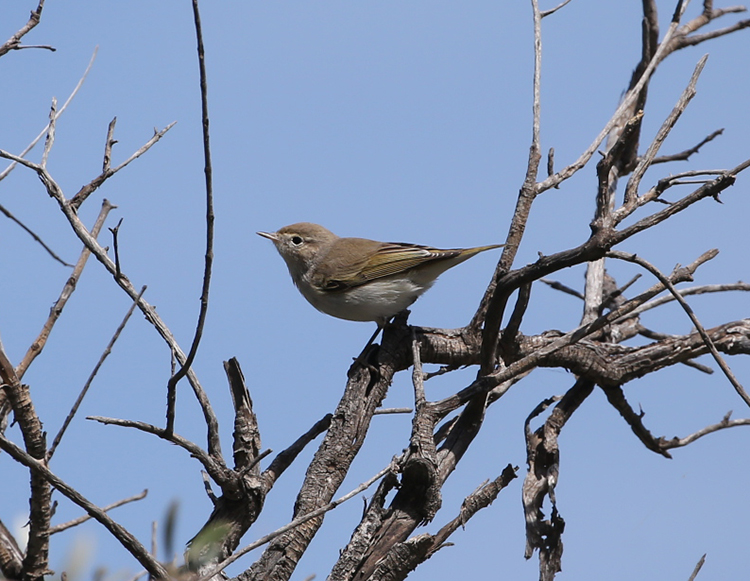
'Northern' type Willow Warbler (?) - The Plantation, Blakeney Point
While Nick went to check the Lupins around the Lifeboat House, I had nice views of a Short-eared Owl as it drifted past along the ridge of dunes.

Lifeboat House, Blakeney Point, Norfolk - 19th May 2013

We began to make our way back, we arrived back at the Bluethroat spot giving ourselves half an hour to see the bird. This time things were much more civil. We were joined by a couple of other birders and we all sat still quietly waiting for the bird to show. However a cold mist rolled in off the sea and the bird remained buried in the Suaeda, probably keeping its head down for the night.
It was now time to start the trudge back. I thought I'd never see the carpark at Coastguards, in fact I couldn't actually see it through the fog and was glad there were a few Blakeney regulars in front of us so we were able to find our way home. By the time we reached the car I was ravenous. Lunch had been a long time ago, my shoulders were killing me and I was shattered. But at least I had the 'Blakeney-experience'.
So on the basis of my first visit there, what would I do to make it that little bit easier next time. Well first of all, bring food and water (which I did), only bring what you need - although I would hate to walk all the way to the Plantation without my camera only to find a cracking bird there giving itself up. A light lens would be good but the only lens I have which is lighter than the 500mm f4 is a 300mm f2.8, they're both bulky. Also, get a good kip the night before and stay off the sauce (definitely don't stay up late watching movies and drinking nice cold beers.....you'll pay the next day..........ahem!). Finally, I would probably hesitate to do it on spec. Only if the winds were good for migrants or if I knew there was a good bird there. It must be tough to track all the way to Plantation only to see a Chiffchaff.
My next blog update won't be for another week. But it will be from the Atlas Mountains of Morocco where Nick and I are headed later in the week for Tristram's Warbler, Atlas Flycatcher and Seebohm's Wheatear amongst other stuff. It promises to be good!

Thursday, 16 May 2013

Not a good bird, a great one!

Wood Warbler is a good bird for Norfolk I believe. For me, no matter where they are, they're not a good bird, they're a great one. I've always loved them, their spinning coin song and plaintive 'puw' call. Lemon yellow throat, white underparts and moss green upperparts. A real gem!
One had been reported in song from a local reserve for the last few days. I was hoping to get there sometime during the week but the weather didn't seem to be suitable, it was either wet or windy or both. However conditions for Thursday morning were looking a little bit more promising, so I headed for bed early Wednesday night setting the alarm for 5am.
At 6am I reached the site, a little later than intended but enough time before work to see the bird. I had good directions but in the end I just followed my ears. I travelled the path through the woods as told and could hear the bird about one hundred yards or so off to my right belting out his familiar tune.
Once I pinned down the exact location I quietly set up my camera and tripod and waited. He would fly from one branch to next, sing for up to thirty seconds before gliding off to the next branch and doing the same, all the while pitching in with a few bars of 'puw-puw-puw'. In my opinion there's no finer birding experience than sitting in a quiet woodland listening to and watching a Wood Warbler doing his stuff! I got a couple of reasonable shots as the light steadily improved and a few movie clips also. By 7.15am, it was time to go to work. I packed up my gear and made my way back to the car with the bird still singing as I left. Not a bad start to the day you could say.

Click this link to see a short movie of Wood Warbler

Click this link for another Wood Warbler movie


Wood Warbler, Norfolk - 16th May 2013

Sunday, 12 May 2013

Warblers finally play ball!

I got a facebook message on Friday from Cork birder Floss Gibson to say that he would be in Norwich for a quick visit. So over a few pints and a curry on Saturday evening we devised a plan to hit a few local spots around Norwich on Sunday.
I picked Floss up at his hotel on Carrow Road at 10am (a respectable hour) and we headed first to Whitlingham CP. The morning had started overcast and warm and a big flock of Swifts were feeding above the visitor car park. We counted about thirty at first but by the time we reached the broad it was clear there were far greater numbers in, hundreds in fact flying low over the water hawking insects.
We stopped after about thirty yards to listen to a Reed Warbler which was singing very close to the path. It was within a few feet but stayed well buried singing away happily to itself. A second Reed Warbler was singing further up the path and a nearby Sedge Warbler was giving it a good run for its money also. We could see movements in the long grass but the bird stayed buried deep, however eventually it broke cover and flew a short distance, pausing briefly to sing from a reed stem and pose for a photo.


Reed Warbler, Whitlingham CP - 12th May 2013
We pushed on. I wanted to show Floss some Garden Warblers so we headed towards a couple of likely spots further along the path. The first place seemed quiet but Floss picked up a single bird moving around in the cover. We watched for a while and noticed a second bird so hopefully a pair. As usual photos were tricky. A Willow Warbler sang in the same area and when I took a few quick shots the bird flew over towards us on hearing the sound of the shutter. It sang a few verses from the branches directly above us before deciding we were not worth bothering with and headed off again.


Willow Warbler, Whitlingham CP - 12th May 2013

Further up the path we had several more Blackcaps, Common Whitethroats, Willow Warblers and Chiffchaffs. We stopped to look at a Common Whitethroat around on the north side of the broad when a bird popped out of the brambles. My first impression was of a pale phyllosc but once I got the bins on it I could see it was my old friend the Garden Warbler. This one was certainly much more showey that the other birds we'd seen but it was still difficult to get a clear shot. At one stage a second bird appeared with it suggesting a pair. One of them posed atop a bramble for a second or two, I fired off a couple of frames before we decided that discretion was required and we left them alone.

Garden Warbler, Whitlingham CP - 12th May 2013
Satisfied with what we had seen I suggested we head to nearby Strumpshaw Fen for Garganey. As we took our lunch in the car park a single Hobby flew overhead. A tick for Floss!
At the first hide we enjoyed great views of two male Marsh Harriers and a Common Tern hunting and dive-bombing.
We walked over towards the tower hide to look for Garganey, sadly we lucked out on these but enjoyed nice views of hundreds of Swifts over the reed beds and high up in the sky. We could see a single Hobby hawking insects but it stayed at quite a distance. With time ticking on we headed back towards the car stopping off at the first hide for one last look, this time we had not one but two Hobbys. As we tried for shots a third bird appeared and we both had binocular views of all three Hobbys hunting together. They remained distant and the skies had darkened, but three together.......fantastic!

Record shot - one of three Hobbys at Strumpshaw fen RSPB - 12th May 2013
Our final stop was Bluebell March at UEA campus for Cuckoo. I had two possibly three birds here earlier in the week but now the temperature was cooler, the rain was starting to come down and there was no sign of any Cuckoos. As the rain got steadily heavier, we decided we had done well enough for the day so headed home.

Tuesday, 7 May 2013

Gardens and Groppers

I had a a very early airport run to do on Monday morning. Polina's Mum needed to be at Luton airport for 6am so we left Norwich at 4am. On our return at 9am, Polina crashed out so I took my chance and headed out for some birding. With excellent directions once again from James Emerson, I headed to Whitlingham CP to look for Garden Warbler.
Garden Warblers are scarce breeders in Ireland, more or less confined to suitable areas around the counties of Monaghan and Fermanagh. Other than that they are scarce migrants on headlands in the spring and more so in the autumn. Apart from a bird in July at Lough Crom, Co. Fermanagh in 2004, I've only ever seen them on headlands and the only time I'd heard one sing was in Latvia in 2011, that time I had to wait to see the bird so I could rule out Barred Warbler, a nice problem to have!
So before reaching the location I had to refresh myself on Garden Warbler song. There were plenty of Blackcaps singing around the broad so I wondered if I could possibly make the mistake of confusing them. However, once I reached the location, I was able to pick out the song straight away. Not quite as melodic as Blackcap, more consistent and steady with less 'flutey' bits really!
Views through the bins were reasonable but getting a photo was a whole other kettle of fish. The bird either moved around a lot or simply sat in cover and sang. So no photo. For such a nondescript, anonymous looking creature I find them really appealing. Their beauty is in their subltey. Their rather plump composure, nice little grey semi-collar, stout bill, beady dark eye and incomplete white eye-ring. You'll forgive me if I dig out an old shot from 2011 of a migrant Garden Warbler on Knockadoon Head, Co. Cork.


Garden Warbler, Cork, Ireland - November 2011
Sylvia Boring they are not!

In all I had at least two birds at Whitlingham yesterday. 

This evening I had directions for Grasshopper Warbler at UEA campus. I left it suitably late enough so the bird would start singing when I got there. I reached the spot, passing a Garden Warbler in song en route (buried in deep cover of course). While I waited for my quarry to start reeling, two Cuckoos chased each other around the reedbeds, I managed one distant record shot of one bird sitting quietly in a willow tree.


Cuckoo - UEA campus, Norwich - 7th May 2013
I think I had a third bird also on the opposite side of the river.
Right on cue at 8.15pm, the Gropper started reeling. A minute or two later it stopped and remained silent for the next forty five minutes. It had just started again at 9pm but by then it time to head home. And of course, photoless :-(

Sunday, 5 May 2013

Breckland birding - Cuckoos and Stone Curlews

With south-westerly winds there was little point in heading for either east or north Norfolk. Migrants would probably be thin on the ground so instead we decided to take a trip around the Brecks to see if we could mop up a few species.
Nick suggested we visit Lakenheath, Weeting Heath and Santon Downham and if anything good turned up on the north coast we would be reasonably well placed to make a dash in that direction.
At Lakenheath Fen a Cuckoo was singing as we stepped out the car, my first of the year (Nick had one earlier in the day not far from Eaton). As we made our way over to the visitor centre, a Cuckoo alighted briefly on a fence post within several meters of the building before being chased off by a second Cuckoo. Hearing them is one thing but seeing them is another, and not one but two! Too quick though for even a record shot.
I asked at the centre if there were any Golden Orioles in, 'None singing' I was told. 'So does that mean there is some females then?' I asked. 'Maybe' was the reply. So with those vague details we headed in the direction of the poplar trees. We didn't see or hear any, maybe some females are there but you'd be doing well to pick them out. We headed along the bank parallel to the plantation listening to Reed and Sedge Warblers and to one of the Cuckoos. We kept an eye out for the male Red-footed Falcon reported from the previous day but didn't see it (it was reported later though). We were, however, a little surprised not to see any Hobbys at all. I believe Lakenheath is used as a staging post by them and when they arrive their numbers can top fifty birds, that has to be impressive.
From Lakenheath we headed next for Weeting Heath, home of that fine Thick-knee, the Stone Curlew. Our luck was a little better here and we enjoyed distant views of three birds from the west hide. And when I mean distant, I mean distant. Not a photographers dream really, but the hides and the reserve are not here for the benefit of us lens jockeys! The only bird I've seen away from Spain was one Julian Wylie found on 20th March 2010 on Sherkin Island in west Cork, so it was good to see these ones.
I cropped the crap out of the shot below and sharpened it to within an inch of its life, you can just about make out that its a Stone Curlew.


Stone Curlew, Weeting Heath, Nofolk - 4th May 2013
From there we headed to a spot near Santon Downham to look for Lesser Spotted Woodpecker. We lucked out on this one too but strolling along the bank of the Little Ouse river we had nice views of three Crossbills (one fine red male and two females) taking a drink from the river's edge. Before I got the lens on them they picked up and headed off with the rest of the flock. Still my best Crossbill views ever, normally only seen they on the tops of conifer trees against the light or flying over going 'chup' chup'. Other then that many of the common warblers were in song, Blackcap, Willow and Chiffchaff as well as plenty of Brimstone butterflys and Orange tips.
From there we passed a couple of likely looking spots outside Thetford for Nightjar or Woodlark, definitely worth staying late in the office some evening and heading there on the way home for some Nightjar action.
Finally we stopped off at the BTO Nunnery lakes reserve in Thetford where we searched in vain for a female Whinchat, we checked suitable habitat but no sign. A flock of six Common Swifts were the best there and the first of the year also for me.
On the way back this nice Red-legged Partridge posed for a few shots. To many others these must be trash birds, but I still like them and this one gave me the only decent photo opportunity of the day.


Red-legged Patridge, Thetford, Norfolk - 4th May 2013
The winds swing a bit to the south and southeast early in the week so next weekend it may be back to some migrant hunting and maybe a visit to north Norfolk to look for Temminck's Stint.


Tuesday, 30 April 2013

A good 'start

My better half is in London for a few days so rather than head home to an empty house I decided to go birding for a few hours after work. I went to a spot in the Brecks where I had heard Tree Pipit, Woodlark and Common Redstart might be possible. While Woodlark or Tree Pipit would be nice it was really Common Redstart that I was after. However, what little information I had didn't suggest that they would be too common. Maybe a handful of birds if I was really lucky.
I had spent an hour and half walking around the location with nothing more to show than a couple of singing Blackcaps, a Green Woodpecker and a Willow Warbler. I had more or less given up when about one hundred yards down the path in front of me a bird flitted down onto a fence post and appeared for a moment to vibrate its tail. I got the bins onto it and could see it was a really handsome male Common Redstart. The light had faded by now (it was almost 8pm) and the bird preferred to keep some space between me and it. I didn't bother for shots and instead watched it for a while as it moved back and forth between the edge of the trees and the fence.
What a stunning bird and only fifteen minutes away from where I work.
I've purposefully kept the location very vague in case there's a female around and they decide to breed (hopefully).


Saturday, 27 April 2013

Hobby and Turtle Dove keep things ticking over

Back out to the east coast this morning to check some migrant spots with Nick Watmough. At Horsey Gap we walked north from the car park passing two or three Common Whitethroats as they sang from the tops of various patches of briars and brambles. We stopped above the caravan park at Waxham Sands and scanned for Pipits and Wagtails. A ground feeding Common Whitethroat threw me for a second or two. In the background I could hear a distant purring sound, interesting and vaguely familiar too. Then the penny dropped, Turtle Dove. I scanned the trees on the opposite side of the caravan park and there it was sitting atop, singing away. Nice...............clearly his one had managed to dodge the hunters guns!
We continued to scan the short grass around the caravan park and picked up four handsome Yellow Wagtails, possibly the same group from last week. And before we moved on we noticed a nice alba Wagtail consorting with two Yarrelli's.
Along the southern path we came across a male Northern Wheatear. This was my first of the year, couldn't let the spring finish without one of these. Yesterday evening it seems that large numbers were grounded by rain on the east Norfolk coast but clearly they had moved on by first light? However, further up the path we came across a few more and at one stage we had up to eleven birds. One or two posed beautifully for photos, but I had been lazy and my camera was back in the car.......bugger!
From Horsey we moved on to allotments at Winterton, best there was a Common Whitethroat, several singing Blackcaps and two female Blackcaps. We checked the dunes very briefly at Winterton but decided fairly quickly, that it was dead.
For lunch we stopped at Ormsby broad, there had been no report this morning of the Purple Heron but maybe no one had checked? As we ate lunch a Cetti's gave a few bursts of song and a Blackcap sang from further down the path. We walked through the woods to the viewing platform, amongst the phragmites along the bank I could hear at least one Reed Warbler singing, a Sedge Warbler sang also but a little half-heartedly. Just before we reached the viewing platform we had views of a small falcon overhead, long wings, shortish tail........Hobby. Out on the broad though there was no sign of the Purple Heron but four Common Terns dropped in for a short spell and a Goldeneye was still present.
With time ticking on, we continued back towards Norwich, stopping at Buckenham Marshes where the best was three Wheatear, four Avocet and a Yellow Wagtail.