First of all thanks to those of you who commented on the previous post either through this blog or on birdforum (mystery acro at knockadoon)
The concensus seems to be that the bird is a Reed Warbler. A Blyth's Reed or Marsh would have been nice but it is more important to have identified the bird correctly.
There are several things I'll take from all of this. First of all there's the learning aspect. What good would it be if I had learnt nothing, Unstreaked acros are very subtle birds especially if they're not singing. I now know at least something about separating juvenile Reed, Blyth's Reed and Marsh Warblers in the field. I have no doubt that'll come in handy some autumn.
Second of all, don't ignore your gut feeling. Based purely on 'jizz' and initial impressions I had this bird as a Reed Warbler. I know you can't base your ID on gut feeling alone but it plays some part in the overall picture. Given that I have seen many Reed and Marsh Warblers in both Ireland and Latvia, that gut feeling would have arisen from my previous experiences with those birds no doubt.
Lastly, when I first realised it was an unstreaked acro I was hoping that it could be a Blyth's Reed (Paddyfield didn't really cross my mind). Why was that though? Well, to my mind Blyth's Reed has a greater rarity value than Marsh. Up until 2006 there had been no records of Blyth's Reed in Ireland. The first record was of a bird initially identified as a Reed Warbler and subsequently re-identifed as a Blyth's Reed based on a review of the photographs. This made the 2007 Mizen Head bird the second record for Ireland having been the first record at the time of discovery (does that all make sense?). Since then there have been regular records almost each year and in 2012 to date there have been four reports of Blyth's Reed Warbler (Inishbofin, Helvick Head, Tory Island and the Beara Peninsula). Still a great bird to find but if you look at the past six years perhaps not so rare. Whether that has anything to do with better awareness or a genuine increase in the numbers of Blyth's Reeds reaching Ireland I have no idea. Their range does appear to have expanded westwards as far as Poland. Marsh Warbler on the other hand is different, at least in recent times. It breeds as close by as Holland, France and Belgium (there was a very small breeding population in the UK but that may be all but gone). However, inexplicably, it remains rare in Ireland. As far as I can recall, in the same period of time (i.e. since 2006) there have only been two records. One was in 2009, a bird ringed in Norway as a Reed Warbler but subsequently trapped on Cape Clear and re-identified as a Marsh Warbler. I twitched that bird and it was a real skulker. The only other record I could remember was of a bird singing at Kilcolman Marsh in Cork in 2010 (I'm not sure if that record has been accepted yet by the IRBC).
So I guess the point I'm making is that if the bird had turned out to be a Marsh Warbler rather than a Blyth's Reed that would have been a little bit more unusual and may have been a catch-up for some birders. It's all a moot point in any case because it has turned out to be a Reed Warbler after all.
Thursday, 1 November 2012

Wednesday, 31 October 2012
Mystery acro
I decided to do a quick check of Knockadoon Head this evening after the showers had cleared. Plenty of Blackbirds, Song Thrushes and Robins about with a single Chiffchaff in the willows near the campsite.
I drove on to the Holy Ground lane and just as I got out of my car I came across this Acro feeding busily in the willows by the galvanised iron gate. It was difficult to get any detail on the bird as it moved around in fairly thick cover. However on the basis of the few shots I got in fading light I was quite happy that the bird is a juvenile Reed Warbler. The main reasons for thinking this were the long primary projection, the buffy rump, undertail coverts and flanks and it lacked the short bill that I'd expect for Blyth's Reed.

 I emailed the above two shots to Owen Foley and he concurred that it lacked features for Blyth's but that I should check the emargination line for Reed and Marsh.
This is where I got confused. According to some of the on-line details I checked, the emargination on P2 for Reed should be in line with the tips of the secondaries and below the tips of the secondaries for Marsh. I cropped the above two shots to see where the emargination is and to me it would appear to be below the tips of the secondaries.
And several other things occurred to me as I worked on these shots. The tips of the primaries are buff / off-white as in Marsh and the feet are yellow - as in Marsh.
So I have several questions;
Can juvenile Marsh Warblers appear buffy?
Is Marsh likely this late in the autumn?
Is the bill right for Marsh - looks a little large to me.
Two final points I might add, firstly the posture looked more 'Reedy' to me. Secondly, the bird was pretty quiet but did give the odd soft tick or tchek but then again I think most unstreaked Acro's do that anyway.
Comments and thoughts welcomed!
I drove on to the Holy Ground lane and just as I got out of my car I came across this Acro feeding busily in the willows by the galvanised iron gate. It was difficult to get any detail on the bird as it moved around in fairly thick cover. However on the basis of the few shots I got in fading light I was quite happy that the bird is a juvenile Reed Warbler. The main reasons for thinking this were the long primary projection, the buffy rump, undertail coverts and flanks and it lacked the short bill that I'd expect for Blyth's Reed.


This is where I got confused. According to some of the on-line details I checked, the emargination on P2 for Reed should be in line with the tips of the secondaries and below the tips of the secondaries for Marsh. I cropped the above two shots to see where the emargination is and to me it would appear to be below the tips of the secondaries.
 |
| Not easy to tell in this photo but the P2 emargination would appear to sit below the secondary tips |
 |
| Emargination on P2 seems below the line of the secondaries |
So I have several questions;
Can juvenile Marsh Warblers appear buffy?
Is Marsh likely this late in the autumn?
Is the bill right for Marsh - looks a little large to me.
Two final points I might add, firstly the posture looked more 'Reedy' to me. Secondly, the bird was pretty quiet but did give the odd soft tick or tchek but then again I think most unstreaked Acro's do that anyway.
Comments and thoughts welcomed!
Tuesday, 30 October 2012
More of the Lesser
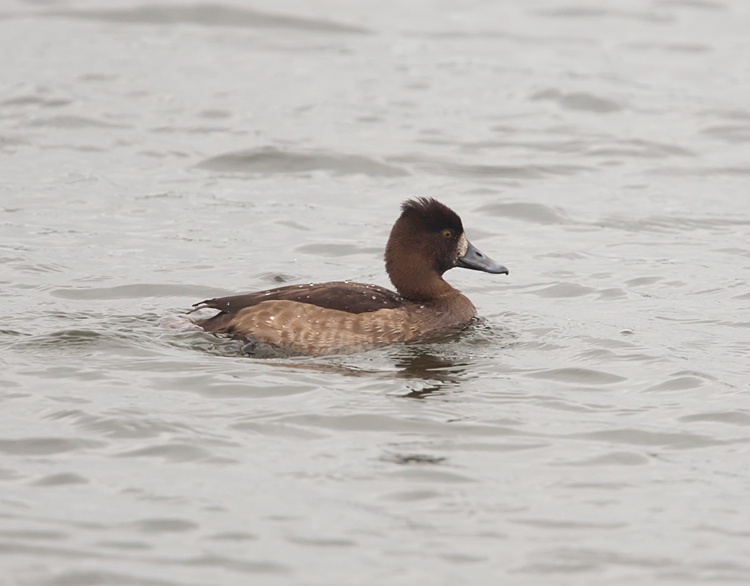
I decided to drop by Rostellan Lake early this morning to see if the Lesser Scaup containing Tufted Duck flock had come in any closer to the carpark. There was no sign as I glanced at the lake from the road but when I pulled up to the carpark guess what.........they were right in! Typically though the light was coming from the wrong direction. Either there was a glare from the water or the birds were all shadowy. However with a little bit of patience and liberal use of the exposure compensation function I managed some reasonable shots.


Satisfied with my efforts I moved on. I'd had enough of bush-whacking for a while so rather than hitting a headland I opted from Ballynamona. Might be worth a check for Jack Snipe or possibly some pipits on the strand. I spent about two hours tramping around in the vain hope of flushing a Jack Snipe, plenty of Common Snipe alright but no sign of their smaller more elusive cousin. No sign either of the Spotted Redshank reported from the weekend. Plenty of Lapwing, a small flock of Golden Plover, five or six Grey Plover, a big flock of Wigeon and about twenty Light-bellied Brent Geese were the best to be had. Two rather large and rotund looking Wheatears on the beach were possibly of the Greenland race (leuccorrhoa). May try to get some snaps of these chaps before they move on.
Footnote: lots of debate since about whether this bird is either a hybrid or even a first winter female Tufted Duck.
Birdforum thread
For the moment I am unticking it, it has since departed the area though the Tuftie flock remains. For me, it always looked just 'different' from the rest of the female Tufties present, I am still holding onto a little bit of hope that it may be a Lesser Scaup and maybe it'll return a little later in the winter when its moult has progressed a bit.......maybe! In the meantime I'm back to needing Lesser Scaup.


 |
| 1st winter Lesser Scaup - Rostellan Lake, Cork, 30th October 2012 |
Footnote: lots of debate since about whether this bird is either a hybrid or even a first winter female Tufted Duck.
Birdforum thread
For the moment I am unticking it, it has since departed the area though the Tuftie flock remains. For me, it always looked just 'different' from the rest of the female Tufties present, I am still holding onto a little bit of hope that it may be a Lesser Scaup and maybe it'll return a little later in the winter when its moult has progressed a bit.......maybe! In the meantime I'm back to needing Lesser Scaup.
Sunday, 28 October 2012
Lesser Scaup at last
Even though the weather was beautiful on Saturday I decided to take a day off and do some other stuff. However late that evening Owen Foley contacted me to say he was 99% sure that he had a Lesser Scaup over at Rostellan Lake. It was near dark at that stage but well worth being there early Sunday morning. Lesser Scaup is a long awaited lifer for me not to mention a very good bird for east Cork. I had plans to head into Cork city Saturday night to partake in the mayhem that is the Cork Guinness Jazz Festival. While I stuck to those plans I decided to take it a bit easy so I could twitch the bird the next morning.
When Owen texted me at 8.30am to say the bird was still there and in quite close to the carpark, I ditched plans for a lie-in and headed straight away to Rostellan.
I arrived at about 10am joining Owen, Dennis O'Sullivan, Paul Moore and John Coveney who had already gotten good views of the bird amongst the small flock of Tufties. It had gone around a corner out of sight just before I arrived but by moving back around to the main Midleton to Aghada road I was able to see it. Views were good but the light was nasty, very dull indeed. The bird appeared to be a first winter female, lighter on the flanks than the Tufties and a large enough white patch around the base of the bill. The peaked hind crown wasn't as striking as I would have expected but there nonetheless.
The flock took flight at one stage and it was just possible to pick out the diagnostic wing pattern on the bird before it landed (i.e. the white on the inner wing did not extend out to the primaries). Unfortunately I never got a shot of the bird with open wings but that may be possible in better light tomorrow.
The temperature was about 9oC and the wind was light, but heck did it feel cold. After an hour watching the bird, Owen and myself went on a coffee run to Whitegate where I filled up on a healthy breakfast roll too.
While all this was going a second subplot had been developing. A Common Sandpiper had been busy feeding on the rocks along the shore to the right hand side of the carpark. It had a suite of features that suggested juvenile Spotted Sandpiper, a short looking tail projection, clean looking tertials and at times yellowish legs (although in poor light I felt it was hard to tell). When we arrived back with the coffee the bird was in very close feeding below the wall. I took as many shots as I could and while many of them were blurred a few came out reasonably well. It certainly looked like a promising individual but we hadn't heard the call or seen the wing pattern. Owen, Denis and Paul were most certainly leaning towards Spotted Sand. Then the bird took flight, just a short distance and without calling. We all got binocular views and were puzzled then when it appeared that the white bars ran all the way in to the inner wing (ala Common Sandpiper).
So it would appear to be a Common Sandpiper with a number of Spotted Sand features........hmmh!?
I've posted some shots below and would invite comment.


A little disappointed by this we turned our attention back to the Lesser Scaup. Light had improved a little and the flock finally came in close enough for a few reasonable shots.


I've never seen the species before however I imagine that getting this close to one is doing very well. They are normally distant specks on large midland lakes in the middle of winter. Great to tick it on such good views. With better light tomorrow I may return for nicer shots. Well done to Owen for a great find, very much doubt I would have picked it out myself, especially in poor light.
I headed to Knockadoon Head afterwards but had little there. Paul Connaughton had a juv. Rosey Starling just before I arrived but we couldn't relocate it. I checked the Hume's garden where Owen had brief views yesterday of a very skulking and silent Pallas's Warbler but to no avail. A male Blackcap at the caravan park was the best bird I had.
When Owen texted me at 8.30am to say the bird was still there and in quite close to the carpark, I ditched plans for a lie-in and headed straight away to Rostellan.
I arrived at about 10am joining Owen, Dennis O'Sullivan, Paul Moore and John Coveney who had already gotten good views of the bird amongst the small flock of Tufties. It had gone around a corner out of sight just before I arrived but by moving back around to the main Midleton to Aghada road I was able to see it. Views were good but the light was nasty, very dull indeed. The bird appeared to be a first winter female, lighter on the flanks than the Tufties and a large enough white patch around the base of the bill. The peaked hind crown wasn't as striking as I would have expected but there nonetheless.
The flock took flight at one stage and it was just possible to pick out the diagnostic wing pattern on the bird before it landed (i.e. the white on the inner wing did not extend out to the primaries). Unfortunately I never got a shot of the bird with open wings but that may be possible in better light tomorrow.
The temperature was about 9oC and the wind was light, but heck did it feel cold. After an hour watching the bird, Owen and myself went on a coffee run to Whitegate where I filled up on a healthy breakfast roll too.
While all this was going a second subplot had been developing. A Common Sandpiper had been busy feeding on the rocks along the shore to the right hand side of the carpark. It had a suite of features that suggested juvenile Spotted Sandpiper, a short looking tail projection, clean looking tertials and at times yellowish legs (although in poor light I felt it was hard to tell). When we arrived back with the coffee the bird was in very close feeding below the wall. I took as many shots as I could and while many of them were blurred a few came out reasonably well. It certainly looked like a promising individual but we hadn't heard the call or seen the wing pattern. Owen, Denis and Paul were most certainly leaning towards Spotted Sand. Then the bird took flight, just a short distance and without calling. We all got binocular views and were puzzled then when it appeared that the white bars ran all the way in to the inner wing (ala Common Sandpiper).
So it would appear to be a Common Sandpiper with a number of Spotted Sand features........hmmh!?
I've posted some shots below and would invite comment.


 |
| Common Sandpiper, Rostellan Lake - 28th October 2012 |

 |
| 1st winter female Lesser Scaup - Rostellan Lake, Cork - 28th October 2012 |
 |
| Dennis O'Sullivan, Alex Jeffares, Owen Foley and Paul Moore twitching the Lesser Scaup at Rostellan lake |
Tuesday, 23 October 2012
A little bit 'fly'
Inishmore continues to steal the show and the drudgery goes on in Cork. I guess we had it good for so long, we were due a bad autumn. I was almost tempted to travel for the Olive-backed Pipit. I set the alarm for 5am hoping to make the 10.30am ferry from Rossaveal. However at 2am I was still staring at the ceiling. There and then I cancelled my plans to travel, needing to be back the same evening, there was no way I'd drive for 8 hours on just 3 hours sleep.
Tuesday morning looked dull and dreary but the Red-breasted Flycatcher at Dirk Bay on Galley Head might be worth going for. A year tick and always a great bird to see. I texted Colin Barton to see if it had been seen that morning but Colin hadn't managed to make it out to Dirk at that stage. I decided to chance it and go anyway. Shortly before reaching Galley Head a tweet confimed it was still there. I arrived at the top of the lane leading down to Dirk Bay and parked up on the grass verge alongside Sean Cronin's jeep. I grabbed my gear and started on my way down the hill to the little wood at the end where I assumed the bird would be. The path down is a pleasure, nice views and an easy descent even with heavy optics, the way back would be different!
The light didn't look great but at least there was no fog or drizzle. When I reached the end of the lane I climbed up the very slippery slope into the wood where Sean was already in place and had just heard and seen the bird a few moments earlier.
After a couple of minutes we both picked it up, restlessly flitting about high in the sycamores. The light was dire though and if it stayed up against the pale, grey sky then shots would be nigh impossible.
I think in total both Sean and I gave it just over an hour and we both enjoyed good binocular views but little enough opportunities for taking photos. At one stage it moved down to eye level just as another birder emerged behind it. The bird dived for cover and stayed hidden. That was 1pm. Sean left, I stayed with the other birder (a UK visitor I think) and for the next 2 hours neither of us saw or heard anything. At 3pm, cold, stiff, hungry and in need of a 'bio-break' I left the wood and trudged all the way back up the steep hill to where I had parked my car. I drove back down, parked up and had my lunch. Feeling a bit more 'ship-shape and bristol-fashion' I decided to give it another go. It was 3.30pm and by now I was on my own (the other guy had thrown the towel in and left without seeing the bird). I headed back up into the woods and parked myself down amongst the bracken and the brambles. I'd thrown a few extra layers on me and had brought a little foam pad to lie on. I perched the camera and lens up on the tripod and waited. Another hour passed and no sign, not a sound! I was beginning to think the Sparrowhawk that had dashed through earlier had dined on the little chap. Every so often I'd hear a Yellow-browed Warbler call from high up in the sycamores but I couldn't seem to pin down where it was. Then at about 4.45pm I heard that distinct soft rattling call. I waited another minute and then below me in the woods about 20 feet away the bird appeared flitting around an ivy covered tree. For the next 20 minutes or so it was busy feeding and calling in the general area below me. There were times when it would seem to hear the sound of my camera shutter and it would fly up into the sycamore directly above me and check me out. Great close views through the bins but useless for photographs. It was great to get my ear in on its distinct rattling call............'wren-like' yes! but softer, not quite so rapid and with occasional soft little 'ticks' added in. A really lovely bird and only my fourth one in Ireland. It posed about 30 feet away for some shots before the light truly packed in and I called it a day.


When I returned to the car I accidently set the alarm off. Talk about shattering the silence. It took me about 30 seconds to dig my keys out and knock it off. I was breathing a little a sigh of relief once the ringing had stopped when my ears were met with a loud Yellow-browed Warbler call. Assuming I had accidently activated the call on my smart-phone I started digging around through my many layers yet again. When I finally fished out the phone I realised that it wasn't what was making the call. There about 10 feet in front of me in the fuschia was the Yellow-browed Warbler. As I raised the camera for a shot it flew towards me and sat up in the sycamore. I got one shot in the fading light before it took off again into the woods.
Just then Micky Sull appeared, we chatted briefly but he was anxious to see the RB Fly so with the light really going he headed off up into the woods and I headed for home.

Tuesday morning looked dull and dreary but the Red-breasted Flycatcher at Dirk Bay on Galley Head might be worth going for. A year tick and always a great bird to see. I texted Colin Barton to see if it had been seen that morning but Colin hadn't managed to make it out to Dirk at that stage. I decided to chance it and go anyway. Shortly before reaching Galley Head a tweet confimed it was still there. I arrived at the top of the lane leading down to Dirk Bay and parked up on the grass verge alongside Sean Cronin's jeep. I grabbed my gear and started on my way down the hill to the little wood at the end where I assumed the bird would be. The path down is a pleasure, nice views and an easy descent even with heavy optics, the way back would be different!
 |
| The road down to Dirk Bay, Galley Head, Cork - 23rd October 2012 |
After a couple of minutes we both picked it up, restlessly flitting about high in the sycamores. The light was dire though and if it stayed up against the pale, grey sky then shots would be nigh impossible.
I think in total both Sean and I gave it just over an hour and we both enjoyed good binocular views but little enough opportunities for taking photos. At one stage it moved down to eye level just as another birder emerged behind it. The bird dived for cover and stayed hidden. That was 1pm. Sean left, I stayed with the other birder (a UK visitor I think) and for the next 2 hours neither of us saw or heard anything. At 3pm, cold, stiff, hungry and in need of a 'bio-break' I left the wood and trudged all the way back up the steep hill to where I had parked my car. I drove back down, parked up and had my lunch. Feeling a bit more 'ship-shape and bristol-fashion' I decided to give it another go. It was 3.30pm and by now I was on my own (the other guy had thrown the towel in and left without seeing the bird). I headed back up into the woods and parked myself down amongst the bracken and the brambles. I'd thrown a few extra layers on me and had brought a little foam pad to lie on. I perched the camera and lens up on the tripod and waited. Another hour passed and no sign, not a sound! I was beginning to think the Sparrowhawk that had dashed through earlier had dined on the little chap. Every so often I'd hear a Yellow-browed Warbler call from high up in the sycamores but I couldn't seem to pin down where it was. Then at about 4.45pm I heard that distinct soft rattling call. I waited another minute and then below me in the woods about 20 feet away the bird appeared flitting around an ivy covered tree. For the next 20 minutes or so it was busy feeding and calling in the general area below me. There were times when it would seem to hear the sound of my camera shutter and it would fly up into the sycamore directly above me and check me out. Great close views through the bins but useless for photographs. It was great to get my ear in on its distinct rattling call............'wren-like' yes! but softer, not quite so rapid and with occasional soft little 'ticks' added in. A really lovely bird and only my fourth one in Ireland. It posed about 30 feet away for some shots before the light truly packed in and I called it a day.


 |
| 1st winter Red-breasted Flycatcher - Dirk Bay, Galley Head, Cork - 23rd October 2012 |
When I returned to the car I accidently set the alarm off. Talk about shattering the silence. It took me about 30 seconds to dig my keys out and knock it off. I was breathing a little a sigh of relief once the ringing had stopped when my ears were met with a loud Yellow-browed Warbler call. Assuming I had accidently activated the call on my smart-phone I started digging around through my many layers yet again. When I finally fished out the phone I realised that it wasn't what was making the call. There about 10 feet in front of me in the fuschia was the Yellow-browed Warbler. As I raised the camera for a shot it flew towards me and sat up in the sycamore. I got one shot in the fading light before it took off again into the woods.
 |
| Yellow-browed Warbler - Dirk Bay, Galley Head, Cork - 23rd October 2012 |

Friday, 19 October 2012
Another tick at Tac!
Things had got so bad in east Cork that I had to get out. More or less everywhere was dead so I figured now was as good a time as any to pay a visit to my sister......who happens to live in Wexford, i.e. near Tacumshin ;-)
I couldn't be rude and just drop my bags and then run out the door to Tac and in any case I was happy to stay a while and catch up with my little sis'. However with a little daylight left I headed to Lingstown hoping to get views of the Bearded Reedlings. I got there about 4.30pm and the sun was already starting to dip a bit. The reedbeds were quiet but I could see a ringtail Hen Harrier hunting off in the distance. I was aware that a Northern Harrier had been reported from the Lingstown area of Tac in recent weeks but I hadn't read up on the key ID features so it would be difficult to pick it out. In any case there was nothing especially unusual about this particular bird. I thought it might be a full adult female. Shortly after I had a ten second view of a male Bearded Reedling bombing across the reeds before dropping out of sight. Still, ten seconds was the longest view I've ever had of these birds. With the light going I decided to check the East End quickly before heading home. I had distant views of a Marsh Harrier which I thought was a juvenile bird judging by its all dark plumage and bright yellow/golden crown. It was distant though and I was mindful that a 2cy Marsh Harrier had been reported a few days before from Tac. Fading light and hunger pangs meant it was time to head back.
That evening I took a little time to review photos on the net of the Northern Harrier. It had been reported from Lingstown by Conor and Donal Foley that day so it'd be worth going back there in the morning and having another look. But I had never seen one before and seperating it from a juvenile Hen Harrier without help would be tricky.
I got to Lingstown at about 10am the next morning. I parked up, put my gear together and began to wait.
Within about 10 minutes I had a harrier coming towards me that looked different. My first impression was that it was very similar to the bird I'd seen in the photos the evening before, it was clearly no ordinary ring-tail.
But the sun was directly in front of me so it was difficult to pick out too much detail. The underparts looked very buffy / rufous with little or no streaking on the breast. It appeared to have a strong hood and the under-side of the secondaries appeared dark as they had done on the photos I'd reviewed the evening before. I fired off a few shots before the bird disappeared from view.


I got back into the car where there was less glare and checked the shots I'd taken. I was pretty certain that this was the bird. In fact so certain that I put out the news. Possibly it was a bit of a risky thing to do but I felt sure. Unfortunately the bird didn't appear again for the next 2 hours but there was plenty of other stuff to see. Every so often I'd hear a chorus of 'pinging' calls as a small flock of between 4-5 Bearded Reedlings flew either over the reeds or high over my head. I couldn't say how many birds there were in total so 'at least' 5 seems reasonable. Far off in the distance I could see a large pale bird settled in a stubble field. With heat haze it was difficult to determine what it was but once I put a scope on it I could tell it was a harrier and when it got up it was clear that it was in fact a fine full male Hen Harrier - a stunning bird indeed. Not long after a Merlin whizzed by and a Short-eared Owl appeared hunting over the reeds. The local corvids gave it a hard though and after a while it rose up, up and up before disappearing off over the dunes.
Time was running out, I needed to be on the road to Cork soon. I decided to check if the Marsh Harrier was still over at Sigginstown but no sign there. A second Merlin was present perched on a fence post and I counted at least 17 Whooper Swans out on the lake amongst hundreds of Wigeon, Shoveller, Gadwall, Mallard and God knows what else.
I had spent two hours at Tac, that barely scratched the surface. I'm not a Tac regular, the birds can often be distant, water levels are often very high (and its therefore tricky if not impossible to cross certain channels especially with heavy gear) and the entire complex is vast so its hard to cover it well, But at least there are birds there, unlike Cork which as I said seems like a depressing wasteland right now. Its sad to think that if a site like Tac existed in the UK it would be properly managed with hides, walkways, a visitor centre and carefully managed for the benefit of the birds and wildlife there. Sadly, in a country our size there just isn't the resources to do this. In the two hours I spent this morning at Tac I had one lifer and five year ticks, what a great spot!
Footnote: I posted some of the above photos on facebook yesterday evening and eagle-eyed Robert Vaughan suggested it might in fact be a different bird. Niall Keogh felt it may be also. Killian Mullarney confirmed this morning that it is in fact a different bird. It is a juvenile female Northern Harrier. The other bird being a juvenile male. Funny I seem to have had some interesting harrier experiences, see 'a 'tail' of two pallids'
Well done and thanks to Niall, Robert and Killian.
I couldn't be rude and just drop my bags and then run out the door to Tac and in any case I was happy to stay a while and catch up with my little sis'. However with a little daylight left I headed to Lingstown hoping to get views of the Bearded Reedlings. I got there about 4.30pm and the sun was already starting to dip a bit. The reedbeds were quiet but I could see a ringtail Hen Harrier hunting off in the distance. I was aware that a Northern Harrier had been reported from the Lingstown area of Tac in recent weeks but I hadn't read up on the key ID features so it would be difficult to pick it out. In any case there was nothing especially unusual about this particular bird. I thought it might be a full adult female. Shortly after I had a ten second view of a male Bearded Reedling bombing across the reeds before dropping out of sight. Still, ten seconds was the longest view I've ever had of these birds. With the light going I decided to check the East End quickly before heading home. I had distant views of a Marsh Harrier which I thought was a juvenile bird judging by its all dark plumage and bright yellow/golden crown. It was distant though and I was mindful that a 2cy Marsh Harrier had been reported a few days before from Tac. Fading light and hunger pangs meant it was time to head back.
That evening I took a little time to review photos on the net of the Northern Harrier. It had been reported from Lingstown by Conor and Donal Foley that day so it'd be worth going back there in the morning and having another look. But I had never seen one before and seperating it from a juvenile Hen Harrier without help would be tricky.
I got to Lingstown at about 10am the next morning. I parked up, put my gear together and began to wait.
 |
| The view of Lingstown reedbed along the barrel of my lens |
Within about 10 minutes I had a harrier coming towards me that looked different. My first impression was that it was very similar to the bird I'd seen in the photos the evening before, it was clearly no ordinary ring-tail.
 |
| Interesting looking harrier - Lingstown, Wexford |
But the sun was directly in front of me so it was difficult to pick out too much detail. The underparts looked very buffy / rufous with little or no streaking on the breast. It appeared to have a strong hood and the under-side of the secondaries appeared dark as they had done on the photos I'd reviewed the evening before. I fired off a few shots before the bird disappeared from view.


 |
| Northern Harrier, Lingstown, Co. Wexford 19th October 2012 |
I got back into the car where there was less glare and checked the shots I'd taken. I was pretty certain that this was the bird. In fact so certain that I put out the news. Possibly it was a bit of a risky thing to do but I felt sure. Unfortunately the bird didn't appear again for the next 2 hours but there was plenty of other stuff to see. Every so often I'd hear a chorus of 'pinging' calls as a small flock of between 4-5 Bearded Reedlings flew either over the reeds or high over my head. I couldn't say how many birds there were in total so 'at least' 5 seems reasonable. Far off in the distance I could see a large pale bird settled in a stubble field. With heat haze it was difficult to determine what it was but once I put a scope on it I could tell it was a harrier and when it got up it was clear that it was in fact a fine full male Hen Harrier - a stunning bird indeed. Not long after a Merlin whizzed by and a Short-eared Owl appeared hunting over the reeds. The local corvids gave it a hard though and after a while it rose up, up and up before disappearing off over the dunes.
Time was running out, I needed to be on the road to Cork soon. I decided to check if the Marsh Harrier was still over at Sigginstown but no sign there. A second Merlin was present perched on a fence post and I counted at least 17 Whooper Swans out on the lake amongst hundreds of Wigeon, Shoveller, Gadwall, Mallard and God knows what else.
I had spent two hours at Tac, that barely scratched the surface. I'm not a Tac regular, the birds can often be distant, water levels are often very high (and its therefore tricky if not impossible to cross certain channels especially with heavy gear) and the entire complex is vast so its hard to cover it well, But at least there are birds there, unlike Cork which as I said seems like a depressing wasteland right now. Its sad to think that if a site like Tac existed in the UK it would be properly managed with hides, walkways, a visitor centre and carefully managed for the benefit of the birds and wildlife there. Sadly, in a country our size there just isn't the resources to do this. In the two hours I spent this morning at Tac I had one lifer and five year ticks, what a great spot!
 |
| Tacumshin Lake - 19th October 2012 |
Well done and thanks to Niall, Robert and Killian.
Monday, 15 October 2012
So long old pal
It was a bit like catching up with an old friend. I first saw this bird in 2007 at Deep Water Quay in Cobh. At the time I had never even seen a Sabine's Gull from a sea-watch or a pelagic so to tick it as it flew a few meters over my head was special. The bird has been coming each autumn to Cobh since 2003. Possibly this is a stop-over point for it as it moves between its breeding ground in arctic Canada to its winter retreat off the skeleton coast of Namibia. A real long distance traveller. It usually appears in late September and by early November it has moved on. Deep water quay must be like a motorway service station on it's long journey south.
A few weeks, Ronan McLaughlin had done a bit of spade-work and established that the bird was first seen in 2003 and that Sabine's Gulls have an average life expectancy of around 8-9 years. Given those details this may be one of the last times we see this bird. It will definitely be for me as this is my final autumn in Cork. A move to the UK takes place in early January. More on that later.
This afternoon the bird was out in the harbour doing its usual circuit, flying out towards Haulbowline Island before coming back in, flying level with the quayside just opposite the train station before heading back out again in a wide arc. Just as it had been the first time I saw it five years ago.
After 20 minutes the drizzle started and quickly got heavier. Not wanting to get my gear wet, I packed up and headed for home. I bade my old friend farewell, wishing them well on their onward journey and thanking them for honouring us once again with a short visit.

A few weeks, Ronan McLaughlin had done a bit of spade-work and established that the bird was first seen in 2003 and that Sabine's Gulls have an average life expectancy of around 8-9 years. Given those details this may be one of the last times we see this bird. It will definitely be for me as this is my final autumn in Cork. A move to the UK takes place in early January. More on that later.
This afternoon the bird was out in the harbour doing its usual circuit, flying out towards Haulbowline Island before coming back in, flying level with the quayside just opposite the train station before heading back out again in a wide arc. Just as it had been the first time I saw it five years ago.
After 20 minutes the drizzle started and quickly got heavier. Not wanting to get my gear wet, I packed up and headed for home. I bade my old friend farewell, wishing them well on their onward journey and thanking them for honouring us once again with a short visit.

 |
| Sabine' Gull, Cobh, Cork - 15th October 2012 |
Subscribe to:
Posts (Atom)